

One of the many challenges in modern filmmaking is to achieve originality, perhaps even more so in the horror genre which has its own array of cliché and trademarks. ‘It Follows’, written and directed by David Robert Mitchell, is an indie chiller that plays up to expectations and subverts them, carrying on the recent up shift in modern suspense films. The plot centres around a sexually transmitted curse which is passed on to lead character Jay (Maika Monroe) in the backseat of her new boyfriend’s car. Faced with the terror of being stalked by creepy entities who take form in all shapes and sizes, she is told to quickly sleep with someone else to ‘pass it on’. Will this rid her of the horrific plague or will she be followed forever, always looking over her shoulder? This intriguing premise plays out with style, creative flair and a thrilling synth-heavy soundtrack, bringing eighties-like scares into the present day.
Category: DVD & Digital
Reviews of the latest UK DVD & Digital releases.
DVD review: The Road Within

After seeing the trailer for German film ‘Vincent Wants to Sea’ in 2010, Los Angeles-based writer and director Gren Wells was instantly inspired to do a US remake, and her version, titled ‘The Road Within’, screens at this year’s Edinburgh International Film Festival. The indie drama explores how young adults manage their mental health disorders, and stars Robert Sheehan as Tourette’s sufferer Vincent who is sent to a behavioural facility following the death of his mother. Whilst trying to settle in, he meets OCD patient Alex (Dev Patel) and anorexic Marie (Zoë Kravitz), and they bond over the constant day-to-day struggles they encounter. When the three mixed-up teens embark on an ad hoc escapee adventure together, their road trip heads in the direction of self-discovery and living life to the fullest, in spite of their problems.
Continue reading this review at Fortitude Magazine!
Read my interview with director Gren Wells!
See the trailer:
DVD review: The Interview

At the best of times, the filmmaking partnership of Judd Apatow school of stoner comedy graduates Seth Rogen and Evan Goldberg isn’t to everyone’s taste. Their latest collaboration though, due to its controversial storyline, has caused a stir like no other leading to distribution complications with Sony Pictures Entertainment and the much publicised talk of nuclear threat against America. Whilst Rogen’s writing and directing bond with Goldberg continues off-screen, his bromance with James Franco grows on it, and the two play the leading roles of TV producer Aaron Rapaport and talk show host Dave Skylark respectively. When their show Skylark Tonight is lambasted for being cheap and only interested in throwaway celebrity culture, they set their target on a more serious news-piece to silence the critics and before long, an opportunity presents itself for Dave to interview supreme leader of North Korea Kim Jong-un. CIA Agent Lacey (Lizzy Caplan) then intervenes, giving instructions to ‘take him out’.
An uneasy mix of politics and toilet humour, the style and the substance of the narrative couldn’t be further apart. The comedy often works but apart from the opening segment involving an excellent Eminem cameo, the strength is contained within the little gags and quippy one-liners rather than the more over-the-top setpieces. As crazy as this sounds, the plot actually gets more ludicrous as it develops, the two friends splitting off into their separate paths as Dave bonds with Kim Jong Un over their mutual love of Katy Perry while Aaron enjoys a lustful pathway with Kim’s regimented propagandist Sook Yung Park. Performance wise, I’ve seen Rogen and Franco on better form and though some of the dialogue is lazily written, it’s fun to see them bounce off one another. Lizzy Caplan brings her Masters of Sex sauciness to the table effectively, tossing herself into a minefield of innuendo. Credit should also go to Randall Park who takes the part of Kim Jong Un. His turn is brave despite essentially being a caricature and figure of ridicule.
For the film that could’ve started World War III, or so Sony would like us to believe, it is largely anti-climactic. More silly than side-splitting though it does have the odd moments of hilarity as well as surprisingly stunning cinematography when the story moves into Asian territory. Perhaps the ambitious premise is a step too far for the masters of juvenile joviality as it just wasn’t funny enough. Their next team project is a 3D animated comedy called ingeniously titled Sausage Party, which from the sounds of it will be much better suited to their line of work. ‘The Interview’ isn’t in the same league as Pineapple Express or the apocalyptic hit This is the End, but for avid fans of this knob-joke laden brand of cinema, it is worth downloading to watch in the comfort of your own home, or wait until it’s on Netflix.

See the trailer:
DVD review: Jauja

The initial bewilderment around how to say the title of Argentinean filmmaker Lisandro Alonso’s latest film is little compared to the confusing elements featured throughout it. ‘Jauja’ (pronounced how-ha) is a Danish-language quasi-western in which father general Gunnar Dinesen (Viggo Mortensen) treks through fantastical desert landscapes in search of his fifteen-year-old daughter Ingeborg (Viilbjørk Malling Agger), after she wanders off with a local soldier. It has impressed in its extensive trail across the festival circuit, from Cannes to this year’s Glasgow Film Festival and is an example of unbridled cinematic escapism, where one man journeys into a mythical unknown shrouded in surreal symbolism.
Narratively, the project has been compared to John Ford’s epic tale The Searchers where John Wayne’s character seeks out his missing niece, but where the camera work there was expansive and unrestricted by boundaries, the framing here is neat and compact, filmed unusually at a 4:3 aspect ratio. Because of this experimental artistic approach, the scenes are picturesque and the tight use of depth and mise-en-scene is fascinating, and at times masterful. However, in contrast to the distance travelled by Gunnar, the storytelling is mostly static, not moving very far or very fast as the running time wears on. The lack of plot development and minimalistic dialogue eventually frustrates and chooses to puzzle its audience at every turn rather than offer any sense of clarity. A second viewing would maybe help solve the sequence of visual riddles it poses.
Viggo Mortensen, best known for his heroic portrayal of Aragorn in the Lord of the Rings film series, must have been an absolute shoe-in to take the leading role given his unique multilingual talents, having childhood roots in the filmmaker’s homeland of Argentina as well as his Scandinavian heritage. It’s a rare Danish speaking part for Mortensen though and also unheard of for writer-director Alonso to work with a well established acting name. The nuanced central performance is key to the film’s enjoyment as we bear witness to a range of fatherly emotions when his vast search descends into sheer peculiarity. His star quality gives the film the boost it requires to carry it through the painfully slow stages, and just about makes the lengthy expedition worthwhile.
See the trailer:
DVD review: Lost River

When it premiered at Cannes festival last year, Ryan Gosling’s hotly anticipated directorial debut ‘Lost River’ was panned almost unanimously, which, as a fan of him as an actor only made me more intrigued to see it. Since the negative initial reaction, it has been tweaked and tinkered for its cinema release with a little shaved off the running time. The title refers to the environment in which the film takes place, a warped wasteland where the American Dream has gone horribly sour. The intertwining plotlines follow three main characters in struggling single mother Billy (Christina Hendricks), her eldest son Bones (Iain De Caestecker) and their neighbour Rat (Saoirse Ronan) as they desperately try to better themselves and their lives, looking for a way out of a decaying habitat with no economic promise. Plucking apparent influences from his pool of experience within the industry, the first-time filmmaker forges his own vision of fractured dreams peppered with fantasy neo-noir elements and striking imagery.
DVD review: Ex Machina

Swapping dystopia for his own brand of utopia, Alex Garland, the writer of 28 Days Later and Never Let Me Go presents his intelligent debut as director ‘Ex Machina’. Continuing the run of thought provoking science-fiction in contemporary cinema, his intimate story follows geeky computer programmer Caleb (Domhnall Gleeson) to the isolated lair of his employer Nathan (Oscar Isaac), after he receives an invite as a prize to a competition. Whizzed off to the secret location by helicopter, he has no idea what to expect and is thrilled when informed that he is to take part in a Turing Test experiment with the highly advanced robot that his boss has built. The machine in question is named Ava (Alicia Vikander) with the test taking place over one week, across several monitored encounters. These meetings, where Caleb and Ava get the chance to ‘know’ each other, form the structure and pacing of the film, giving a steady, if at times repetitive, platform in which to handle the ever-expansive psychological and technological themes.
Set in only one slickly futuristic yet somehow cold creepy environment with only three predominant characters, the fixed set up lends the film an unnerving sense of claustrophobia that lurks throughout. The relationships between the three are never simple, always transforming and simmering with complex tension. The script is sharp and intellectual and makes every conversation that takes place interesting and full of acumen. Regular power cuts in the building serve as a plot device as Caleb, Nathan and Ava try and stay one step ahead of each other, and in turn keeps the audience not only guessing what will happen next but also pondering the all encompassing questions that it poses of humanity, artificial intelligence and the blurred lines in between.
Because we are trapped in a tight space with only a few faces to keep us company, it is even more important that the acting is up to scratch. Gleeson certainly works as the wide-eyed inquisitive central figure, and his casting brings out comparisons and similarities with a certain episode Charlie Brooker’s sci-satirical series Black Mirror in which he plays a man who dies and is rebuilt through his virtual personality on social media. This could easily be mistaken for a feature length sequel. As good as Gleeson is though, he is third best behind Isaac and Vikander. The former is menacing and controlling in his role, but also brings black humour with excellent delivery and a shockingly good dance sequence. Alicia Vikander portrays the humanoid Ava with such careful precision, every expression and every step is measured to perfection and I could listen to her talk all day.
Alex Garland brings his already accomplished novelistic craft to the project, as well as flexing his directorial muscles, bringing refreshing creativity and visual flair. In ‘Ex Machina’, he sets and establishes a scary setting in which his absorbing concept can be explored, and though a couple of minor plotholes leave things unanswered, his ideas are given ample room to develop. What stands out and has a lasting effect though are the actions of the fascinating characters, and the consequences of them. Gleeson and Vikander’s man and machine connection make this glimpse at what the future may hold far more human than Her, as Oscar Isaac pulls the strings of reclusive genius Nathan, the manipulator of this modern monster of a film.

See the trailer:
DVD review: The Gambler
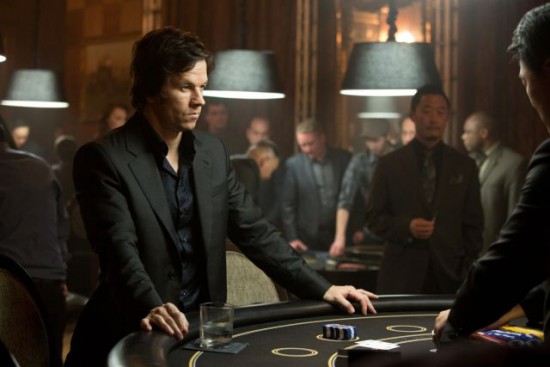
Mark Wahlberg continues his questionable vein of form, taking the titular role in British director Rupert Wyatt’s remake of 1974 film ‘The Gambler’. Mimicking the great James Caan who had the lead in the original written by James Toback, he plays literature professor by day, compulsive risk-taker by night Jim Bennett. Set in a greasy depiction of Downtown Los Angeles, Bennett recklessly lands himself in debt with both the proprietor of an underground casino and menacing mob boss Neville Baraka (Michael Kenneth Williams). Turning to wily loan shark Frank (John Goodman) and befriending impressionable student Amy (Brie Larson), he aims to dig a way out of the mess he got himself into, but like a petulant child refuses to take responsibility for his actions. With his fate likely to be decided on the turning of a card, can he turn his luck around and get everything he has ever wanted or is he destined to lose it all?
With an intriguing premise and an impressive cast, the foundations were laid for an exciting watch. In the gambling den scenes with the background clinking of the chips and whirling of the roulette wheel, a suspenseful buzz is achieved. Unfortunately, the buzz soon wears off and the disappointingly William Monahan’s shoddy script allows the protagonist to continually spout off quasi-intellectual speeches about his philosophies on life and how unfair the world is. Somehow, his garbling brings about an unfeasible romantic subplot that has about as much sexual tension as a trip to the chiropodist. The incoherent narrative isn’t helped by the distracting shuffle-all soundtrack, tacky visual effects and a series of odd camera tricks and weird angles that look as though they’ve been compiled for a cinematographer’s show reel.
Mark Wahlberg is horribly miscast as Bennett, and you never quite understand or see any reasoning behind anything that he does, meaning that his character arc is virtually a straight line. The veteran actors supporting do offer some respite from the intolerable central performance, in particular the aforementioned John Goodman and also Jessica Lange, who plays Bennett’s wealthy mother who appears to have bailed him out one too many times in the past. Brie Larson, who is usually so good if you take her appearances in Short Term 12 and The Spectacular Now as examples of her talent, is vacant in a role that serves purely as a bad storytelling device.
The main problem behind ‘The Gambler’ is that we, as an audience, should always be rooting for Jim Bennett’s gamble to pay off eventually despite his flaws but by the final act, I really didn’t care. The idea of the self-loathing addict has so much potential and there are countless possibilities to exploring the themes and dissecting the psychological torment of someone who never really feels like a winner, choosing to chase the unreachable dream. For me, Wyatt’s glossy, haphazard execution is ultimately a wasted opportunity that should have been odds-on for success, and no matter how much Bennett appeared to hate himself, I think I hated him just that little bit more.
See the trailer:
DVD review: American Sniper

Chris Kyle is the most deadly sniper in US military history, with an astonishing 160 kills to his name. His stretch as a Navy SEAL on and off-duty is documented in war drama ‘American Sniper’, directed by Clint Eastwood and based on Kyle’s autobiography of the same name. Kyle (Bradley Cooper) was sent to Iraq following the September 11 attacks of 2001, leaving behind his wife Taya (Sienna Miller) to become a highly respected figure among the American forces, and dubbed ‘the Devil of Ramadi’ by Iraqi insurgents. The film has a clear target, aiming directly at the mindset of the protagonist, and how circumstances of warfare affect him psychologically as he serves four tours for god and country. Shrouded in controversy because of the arguably misguided patriotism and political themes throughout, this biopic isn’t your typical war movie, but is the filmmaker’s directorial vision as clear as that of the marksman himself?
A hugely intense opening scene immediately places the audience at the heart of the conflict, and we get a glimpse into the laid-back psyche of Chris Kyle before his run of kills. Flashbacks and the structure of the narrative then go on to illustrate an acute character study, tracking the pressures he faced during his childhood, his American Dream-like family life and of course his experiences of the war on terror. Bradley Cooper’s impressive performance goes a long way to giving a strong portrayal of Kyle, his inner traumas demonstrated through his facial expressions rather than his words. His priorities become increasingly blurred as his need to defend his country outweighs his responsibilities as a husband, and as a father. Creative flourishes to dramatise scenarios and introduce an arch-nemesis figure cheapen the true events as the plot develops, meaning that the marital drama, which is possibly the most interesting aspect of the film plays second fiddle to repetitive shoot-outs. As a result of this, Sienna Miller doesn’t get the screen time she deserves as Kyle’s suffering wife, but when she is called upon, she is used effectively.
Despite being marred by a fictionally heightened sense of heroism, ‘American Sniper’ is a solid addition to the modern-war genre, boosted by the two central acting performances. Cooper’s turn offers some insight and understanding of the narrow mental state of those fighting for their country, and the struggles they encounter when trying to adjust back into their day-to-day lives. I feel there’s been much stronger leading male performances across the year of cinema, but the timing of the release and the subject matter have no doubt contributed to his third consecutive Oscar nomination. Chris Kyle, though not an entirely likeable personality, has a fascinating story that deserves to be told and Clint Eastwood delivers a cinematic tribute that strays between gripping and grim.

See the trailer:
DVD review: Whiplash

An intense, edge of your seat, drama about jazz music would appear about as plausible as a feel-good flick in a funeral parlour but that’s exactly what director Damien Chazelle achieves with ‘Whiplash’. Music school drummer Andrew Neimann (Miles Teller) is young and impressionable, determined to be the next big sensation of the jazz scene. Standing in his way is intimidating conductor/mentor Terence Fletcher (J.K. Simmons) whose exceptionally high standards lend him extreme methods of coaching. Are his unorthodox teaching techniques necessary means to an end or is he bitterly blocking the threshold to stardom because he himself feels he has underachieved?