(Muse) (In Greek and Roman mythology) each of nine goddesses, the daughters of Zeus and Mnemosyne, who preside over the arts and sciences.
A woman, or a force personified as a woman, who is the source of inspiration for a creative artist: Yeats’ muse, Maud Gonne
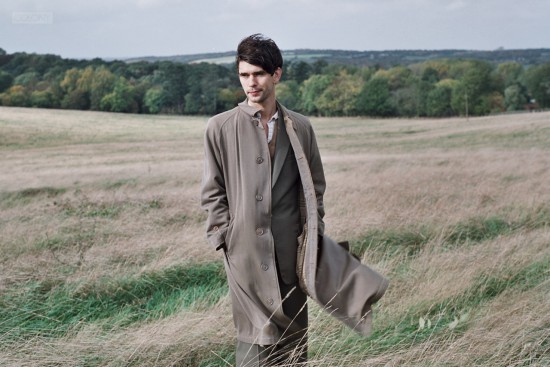
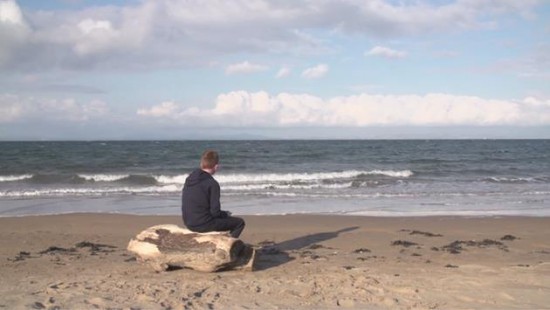
In the creative industries, it is vitally important to always be inspired for each and every project you take on and fashion photographer Tim Walker has turned film director to explore this theme further. His piece, simply titled ‘The Muse’ features Ben Whishaw in the leading role, who rose to fame in 2012 after playing James Bond’s go-to-gadget-guru Q in Skyfall. He plays struggling artist Edward who is lost without his muse (Kristen McMenamy), and left to reflect over what he had, mourning his source of invention and imagination.
It is refreshing to watch Walker liberated from still photography to work with the moving image, and his strong visual style transfers beautifully across mediums. Each frame of the film is deliberated over and could easily be captured to go on display. Structurally, the minimalist narrative floats through in a wash of ambiguity, as Edward mopes about in despair, his internal monologue the only dialogue, while his mermaid muse gazes out of a water-tank in what are beguilingly fantastical-flashback-dream sequences. I feel that it could benefit from the accompaniment of an exhibition space to fully flesh out the thought process involved, but with the behind-the-scenes bundle available at www.wearecolony.com, you can get access to the full film as well as stills, concept art, sketches and more!
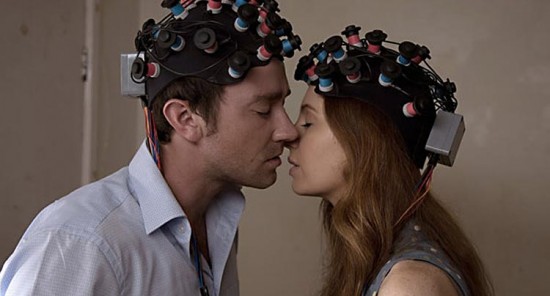
A new breed of films are surfacing in the forever changing cinema industry. Independent science fiction, or sci-findie if you will, is a forming genre which takes elements of futuristic technology – in this case time travel – and applies it to a simple story, with no aliens or laser beams in sight. Australian comedy ‘The Infinite Man’, written and directed by Hugh Sullivan, has one location, three actors but a great deal of creativity and intelligence. Dean (Josh McConville) wants to recreate the perfect anniversary weekend with his girlfriend Lana (Hannah Marshall). He takes her to same holiday resort, which unbeknownst to him is now closed and deserted, and has an agenda to repeat the same activities. However, when Hannah’s ex Terry (Alex Dimitriades) appears, his carefully laid plans go terribly awry.
One year later, a heartbroken Dean digs out a ridiculously looking time-travel device which he has cooked up ‘in the lab’ and proceeds to send himself and Lana back in time to give it another go. Of course, this backfires when his current self follows suit, trapping the characters in an infinite loop of misery, jealousy and hilarity. Despite the narrative repeating itself, it never becomes uninteresting and actually gets funnier as the plot develops and we see Dean become hysterical in his pursuit of eternal happiness. The dialogue has the same quirky edge and unenthused tones as that in the New Zealand sitcom Flight of the Conchords, and is delivered with impressive comic ability by all involved.
The inventiveness of the plotting means that the viewer is always kept thinking, and the low-budget environment becomes an intimate microcosm of unrequited love. I hope that the work will reach a wide audience after its festival reception, and it’d be intriguing to see where the ideas could travel with more money to spend. Until then, ‘The Infinite Man’ is substantial proof that big ideas can work well on the smallest of scales, and is a notable feature debut for film-maker Hugh Sullivan.
Christopher Nolan is undeniably one of the most ambitious, forward thinking filmmakers working in the industry today. Known for writing and directing mind-bending films such as Inception and Memento, his thought-provoking style pushes the boundaries of cinema, challenging audiences to unravel his narratives. His latest picture is sci-fi epic ‘Interstellar’ and it is perhaps his most daring yet. Set on a decaying planet Earth running low on natural resources, Matthew McConaughey takes the leading role as former NASA pilot Cooper and is tasked with the almighty responsibility of finding a new home planet for the human race. After much deliberation with his daughter Murphy (Mackenzie Foy) and persuasion from Professor Brand (Michael Caine), he leaves his family behind for the greater good, taking off with biologist Amelia (Anne Hathaway) for a journey through space and time.
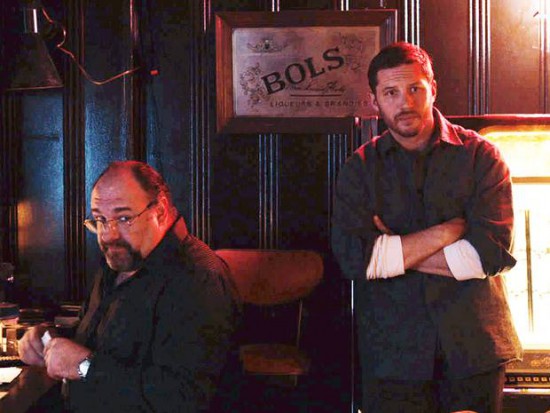
In a year that has pushed the envelope in terms of experimental filmmaking, is there still a demand for simplistic cinema? Or is it in fact more ambitious to do the stripped-back style well, with solid acting and an intelligent script, than convolute your story with gimmicks to stand out from the crowd? Belgian director Michaël R. Roskam brings together an excellent cast for neo-noir drama ‘The Drop’, which harks back to the classic gangster genre movies where nobody can be trusted and danger lurks around every corner. Tom Hardy stars as soft-spoken and unassuming bartender Bob Saginowski who looks after a drinking den alongside his Cousin Marv (James Gandolfini), which is regularly used as a ‘drop’ for the local lowlifes to launder their illegally gotten gains. When a robbery takes place after hours, Bob and Marv find themselves in a precarious predicament, forced to face the wrath of the mob.
Brooklyn’s grimy underworld provides the backdrop for Dennis Lehane’s tightly woven script to unfold. Having previously worked on The Wire as well as collaborating with legendary crime film director Scorsese, his influences are clear as they bleed into the flawed but fascinating characters. Very much character driven rather than narrative driven, the study of the morals and masculinity of the protagonists is always interesting and an appealing subplot plays out naturally about the responsibilities involved in taking on a pit bull pup. While events never really veer too far out of the ordinary story-wise, Roskam puts on a masterclass in tension building, heightening to a satisfying final third.
It is of course terribly sad that this film will mostly be remembered for featuring James Gandolfini’s final screen performance, but it is testament to how phenomenally gifted he was as an actor. Widely known for his long-running portrayal of New Jersey mob boss Tony Soprano, he was an expert in complex multi-faceted drama and playing cowardly Cousin Marv serves as a fitting swansong. Not to be outdone though is Tom Hardy, who matches Gandolfini blow for blow in a battle of acting prowess and again proves himself as one of the best of his generation. He gives a controlled and more subtle turn than we are used to seeing from him, nailing the accent and showing that sometimes less is more.
‘The Drop’ is an effective throwback genre picture, and what it lacks in narrative imagination, it makes up for with the powerful screen presence of the leads. The term ‘actor’s movie’ has never felt more apt. Roskam and screenwriter Lehane present a bleak Brooklyn exterior, an unappealing interpretation of the big apple which hides a black and bloody core of corruption. In this environment, it is equally dangerous whether you’re propping up the bar or serving beers with Bob and Marv from behind it, but where Hardy and Gandolfini are concerned, consider the metaphorical acting bar raised.
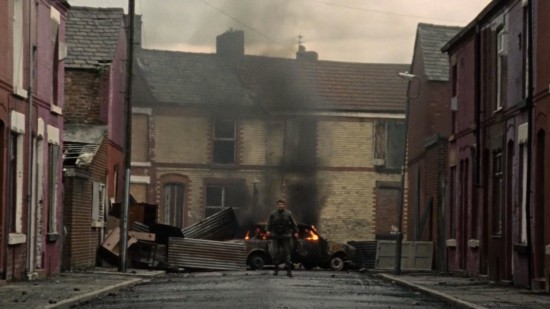
In his feature length debut, Yann Demange’s action thriller takes us to the height of the Troubles in Belfast where political conflict lasted for over a quarter of a century. We witness the hostilities through the fearful eyes of a young British soldier called Gary Hook (Jack O’Connell) whose squad is caught in the middle of a riot, and who is accidentally left behind by his unit after events go terribly awry. As he desperately tries to get back to his barracks and fights for survival, he becomes embroiled in a local war of corruption and betrayal. This is a brutally realistic depiction of terror, enhanced by yet another stunning performance from one of Britain’s best.
There is a patient build-up as we’re first introduced to Private Gary Hook, and we get vital glimpses of his youthful innocence before he is thrust into the face of danger. The grainy cinematography as well as the shaky camera techniques assist in creating a pragmatically dangerous environment. An excellent chase sequence had me gripped as the protagonist is hunted down by a ruthless gang of nationalists. Tension drops slightly as Hook meets a young impressionable protestant who seems born to hate the ‘fenian bastards’ as he so eloquently, and continuously puts it. Their brief encounter offers the only glimmer of humour as the youngster struts the dishevelled streets like a mafia boss, but the friendship is brought to an abrupt, shocking climax which highlights the atmosphere of the film and illustrates how treacherous the situation was in Northern Ireland at that time.
In a role much more subtle and understated than we are used to, Jack O’Connell is excellent. With very little dialogue, his performance relies on his range of expression as well as his general screen presence. Earlier this year, we saw him in Starred Up as a disturbed prisoner, visceral and violent. Here, he is vulnerable, and lost in a antagonistic environment that he knows little about. Support comes in force from Paul Anderson and Sean Harris as crooked figures of authority. Harris’ squirrel faced villain is chilling, and with trouble around every corner, so-called factions are paper thin as every character seems willing to stab their allies in the back. The final third plays out a little predictably, though not without moments on extreme intensity as all sides close in on Hook and each other.
The focus of the thriller as a whole leans less on being a story of the Troubles as such, and more a survival movie as the lead is attacked from all angles throughout. It marks an impressive foray into cinema for the director Demange, who along with writer Gregory Burke and composer David Holmes, captures the threatening mood brilliantly. The main strength of the piece is the central turn from O’Connell. We’ll see him on the big screen again soon, this time as an American soldier in Angelina Jolie’s WWII directorial debut Unbroken, which demonstrates the impact he is having within the industry. Until then, we can celebrate the year he has in British film – the rising star has reached new heights.
Joseph Mallord William Turner was a complicated man, revered for his pioneering painting style, but his reputation tainted by his life away from the easel. In typically fluid fashion, veteran British filmmaker Mike Leigh writes and directs a biopic of the artist, which looks at the latter stages of Turner’s life. The great Timothy Spall stars in the eponymous role, and the narrative follows how he balanced his passion for his art with his personal demons. Both Leigh and his regular cinematographer Dick Pope are long-time fans of J.M.W. Turner and this comes across strongly on-screen as the director’s style departs from the zany and improvisational and is executed with great care and precision.
Inspired by his own film Beautiful Young Minds, British filmmaker Morgan Matthews directs ‘X+Y’, a story of a young boy with autism who has a gift for mathematics. The cast includes Asa Butterfield, Rafe Spall, Eddie Marsan and Sally Hawkins. It screened at Glasgow Film Festival and I was fortunate enough to speak to Morgan Matthews about the project…
Coming from a career in documentary filmmaking, why was this the right time for your first foray into feature fiction?
I’ve made a lot of documentaries and have done so in differing styles but at the same time felt that I was making them in quite a similar way. I want to be creatively challenged every time I make a film and try all the different forms of storytelling, and whether it’s documentary or fiction you’re still telling a story. In some ways there are a lot of similarities.
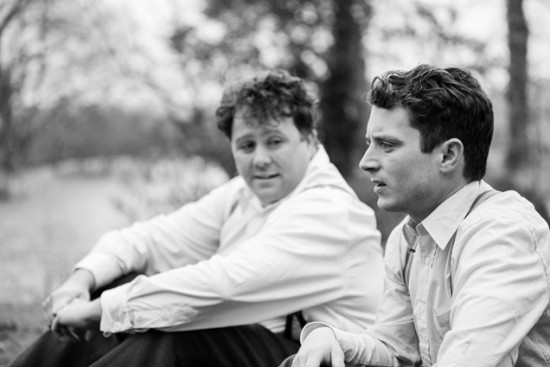
In 1950, the troubled Welsh poet Dylan Thomas ventured to New York City to read at universities around the country. The man who made this possible was a professor called John Malcolm Brinnin. His account of this time, titled Dylan Thomas in America has formed the film ‘Set Fire to the Stars’, directed by Andy Goddard. Elijah Wood and Celyn Jones star as Brinnin and Thomas respectively. Filmed in glorious black and white, the story explores their friendship and Brinnin’s struggle to understand and tame Thomas’ whirlwind lifestyle as he spirals out of control.
The stylish, often snowy, city backdrop is presented impeccably, the clean and slick cinematography suitably matches John’s pristine appearance but clashes with Dylan’s haphazard existence. Initially, after an excellent opening sequence, it seems as though Brinnin, who is an obvious admirer of his work, is using Thomas for his own personal gain, but as he peels back the layers of his complex individual, he soon cares for and befriends the tortured soul. Dylan deflects attention to his talent by causing controversy and making lewd remarks, including reciting inappropriate yet amusing limericks. The performances though, of the poetry itself, are electric.
Despite their differences, they share the odd moment of togetherness and acknowledge the mutual respect they have for one another. A scene in which they pull an all-nighter to grade student’s work is majestic, as they discuss language over coffee and cigarettes. The mise-en-scène showing the passing of time is poetry in motion. Wood and Jones perform very well, and bring the necessary charisma and energy to their roles. An impressive supporting cast including Shirley Henderson, Kevin Eldon and Kelly Reilly is solid, and their characters are involved in carving out the personas of the two leading men, showing other facets of their deep personalities and hinting at their complicated pasts.
‘Set Fire to the Stars’ illustrates the fact that you don’t have to be a musician to live the rock and roll way, and Dylan Thomas is proof of that. In the city that never sleeps, he enjoyed an excess of fatty food, red eye liquor and feisty women while Brinnin cleaned up the mess he left behind. This is an enjoyable, and informative biopic with an excellent display of acting that sheds some light on the man behind the words of wizardry. Dylan says to John in one scene whilst dissecting his poetry that understanding is the least important thing, and that feeling the emotion behind it comes first. Perhaps the same could be set for him as an artist and his life, and this adaptation certainly feels satisfying.
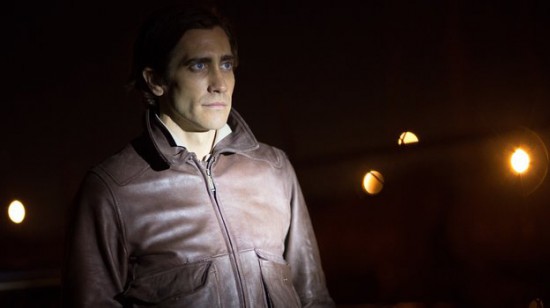
‘If it bleeds, it leads’ is the heartless crime journalism motto in noir thriller, ‘Nightcrawler’ written and directed by first-timer Dan Gilroy. The film is centred wholly around entrepreneurial nutcase Lou Bloom (Jake Gyllenhaal) who roams the neon lit streets of Los Angeles in search of a money-making scheme. When he witnesses a terrible highway accident and a man capturing the events on camera, he sees an opportunity to capitalise on, deciding to have a go himself, selling his grisly footage to the highest bidding news station. This dark slice of cinema is fascinating throughout, exploring the moral philosophies of freelance reporting through the eyes of and focussed through the lens of a driven, but extremely intelligent lunatic, who will stop at nothing to get what he wants.
The narrative ticks along at an alarming pace as Bloom quickly builds his reputation, hiring Rick as his hard-working assistant and forming a working relationship with Nina, a news channel director. Lou continuously pushes his assets to the absolute limits, always wanting more sales, more success and consequently more money. The gloomy style of the cinematography along with an unsettling score combine to create a creepy cloud that descends on LA after dark and is the suitable environment for the complex protagonist to go about his business. By day, he is calculating and clever, delivering motivational nuggets to justify his motives. When pestering a potential employer, he argues that ‘if you want to win the lottery, you have to make the money to buy a ticket’. By night, he is equally direct and eloquent in his methods of madness but possesses a cruel, dangerous streak.
Jake Gyllenhaal, who also produced the project, describes his latest character as a human interpretation of a coyote, lurking in the shadows of the metropolis. He lost twenty pounds in weight for the role and his gaunt look and inhumane glare give Lou Bloom a chilling exterior to match the mercilessness behind the glazy eyes. Aspects of other cinematic anti-heroes can be pulled from the intricacies of Lou Bloom; he has the social awkwardness of Travis Bickle and the driving prowess of Gosling’s unnamed stunt driver, as well as the psychotic tendencies of Patrick Bateman. These combined attributes though make Bloom memorable in his own right, and Gyllenhaal is scarily good in his portrayal. Excellent support comes from British star Riz Ahmed as Bloom’s loyal aide who goes against his ethical scruples in his desperation for steady employment.
‘Nightcrawler’ continues an interesting trend of major acting talent turning to darker, indie material in order to get more in-depth satisfying roles, though Gyllenhaal now finds himself on the wrong side of the moral compass, following his previous authoritative parts. Following Bloom from one crime scene to the next, we as an audience become almost complicit in his wicked ways, laughing at his words of warped wisdom and absorbed in his murky profession. While discussing his line of work with a police officer, he gleefully states ‘I like to think that if you see me, you’re having the worst day of your life’. I would never want to come across his kind face to face but on-screen, his company is well worth your time.
Founded by Edinburgh-based screenwriter and director Neil Rolland, Write Shoot Cut offers a platform to up and coming filmmakers to discover their talent and also showcases their work at local cinemas. Whatever aspect of the creative process you are interested in whether it is writing, directing, editing or producing, the opportunity is there to get involved, learn new skills and most importantly have fun. I’ve been fortunate enough to attend events held by the Write Shoot Cut team and have taken the opportunity to network with those involved. The enthusiasm behind the projects is inspiring. As part of new movement Tartan Features which encourages and celebrates micro-budget feature filmmaking, Neil Rolland’s debut titled ‘Take it Back and Start All Over’ screened at Edinburgh Filmhouse ahead of short film ‘James and the Urn’ by Louis Clark.
James and the Urn
Originally written as part of a ‘death trilogy’, themes of loss and mourning are ever-present in Louis Clark’s short ‘James and the Urn’. The dialogue light narrative follows the eponymous James (Ryan Gerrard) who finds his grandmother dead in her home. The grief-stricken boy struggles to cope as life moves on around him, so takes action in order to come to terms with death. An impressive mix of tight camera work, efficient editing and unnerving sound design help convey an atmosphere of melancholy and loneliness as James blocks out the world around him.
Take it Back and Start All Over
This ambitious film was shot over just five days on a budget of £1000 and is a fantastic example of using the resources available to you to the very best effect. The plot tracks the turbulent relationship of Jennie (Kerri Clarence) and Brian (Neil Rolland) as they struggle with the domesticities of marriage following the birth of their daughter. The message at the film’s core is one that most of us can relate to whereby the humdrum routine of day-to-day life continually gets in the way of the desire to follow your dreams. For Jennie, her dream is music and she yearns to rediscover her self as a singer-songwriter, despite the lack of support from her selfish husband. The strain ultimately takes its toll on the couple and the acting out of their struggles is always very natural and often moving, helped by the fact that Jennie and their daughter Evie are played by Neil’s actual wife and daughter. This allows for a Blue Valentine-esque flashback which really works, contrasting wedded bliss with marital misery. The supporting cast, which includes Kyle Titterton and Game of Throne’s star Kate Dickie are equally excellent in their roles. ‘Take it Back and Start All Over’ is very much a personal project for Neil Rolland who was writer, director, actor, editor, producer as well as writing all of the original songs used in the film, so to take all that on board and have a great film at the end of it all is an astounding achievement.