
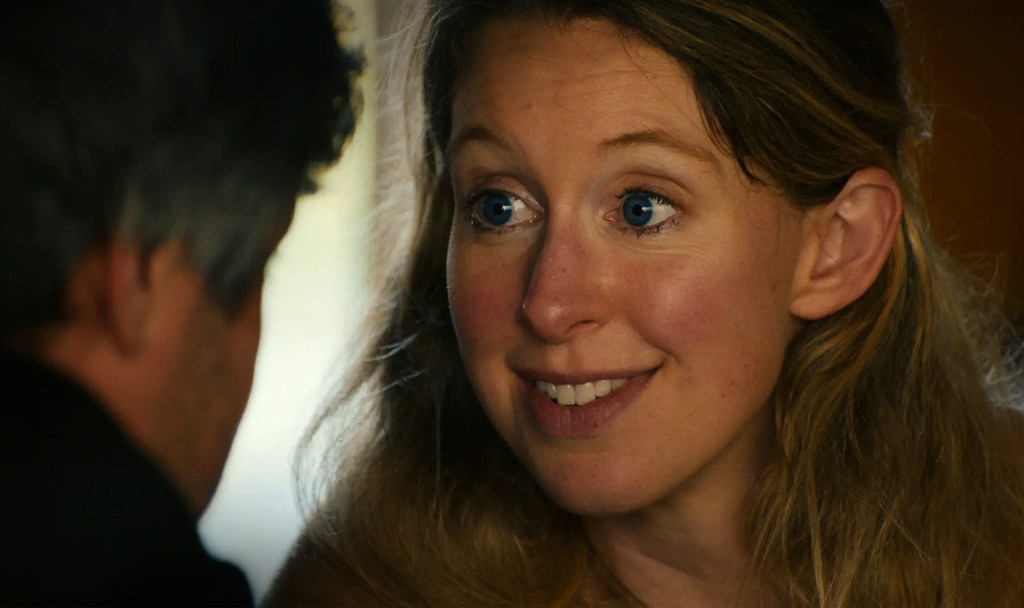
Biotechnology businesswoman Elizabeth Holmes made headlines in 2015 when Forbes named her the youngest and wealthiest self-made female billionaire in the US. Shortly after, her much-publicised downfall began as she was found guilty of defrauding investors in her defective blood-testing device. Her controversial story was adapted into dramatised mini-series The Dropout in which Amanda Seyfried portrayed the disgraced magnate, and is now being revisited in experimental documentary You Can See Everything. Picking up around a month before Holmes’ 11-year federal prison sentence, directors Nathan Fielder and Lance Oppenheim along with their crew are invited into the beach house she shares with her partner Billy and their two young children where the aim is to offer “radical transparency”.
Tapping into our cultural obsession with true crime docs, the film wastes no time in setting up the premise with on-screen text and establishing an interrogative but strangely comedic tone. Taking an almost arthouse-like visual approach, the camera is less fly-on-the-wall and more fly-in-the-face as the invasive lens is startlingly close to its subjects during gently probing conversations. Often lurking awkwardly in the background, Fielder becomes a Theroux-esque presence – a keen voyeur of sorts to Elizabeth and Billy’s daily routine of parenting and whisking eggs at breakfast. The film goes on to intimately examine the semantics of Holmes’ fraudulent claims whilst digging into her complex relationship as well as past trauma. The way in which Oppenheim and Fielder explore truth and perception is fascinating and frequently gripping in the run-up to her looming incarceration.
Heading into the final act of its nearly three hour runtime, there’s an ingenious and audacious format flip which turns the narrative on its head. In taking this wild leap into meta-filmmaking, You Can See Everything almost becomes a satirical reinvention of the documentary genre itself, calling into question the motivations of the directors and authenticity of everything we have witnessed. In the world of smoke and mirrors we live in as a society, Oppenheim and Fielder perform a daring magic trick of cinema and by letting us behind the curtain, it makes it even more compelling and impressive.