
His neon-soaked pictures are often critiqued as ‘style over substance’ and after a decade away from the big screen, Danish auteur Nicolas Winding Refn is back to polarize audiences again with his latest effort, Her Private Hell. The sci-fi psychological thriller follows actress Elle (Sophie Thatcher) who meets influencer Hunter (Kristine Froseth) ahead of their shoot on a new film by her problematic filmmaker father, Johnny Thunders (Dougray Scott). As he skips town, encouraging Elle to bury the hatchet with her stepmother Dominique (Havana Rose Liu), she crosses paths with a brooding G.I. known as Private K (Charles Melton) who is searching for his own daughter.
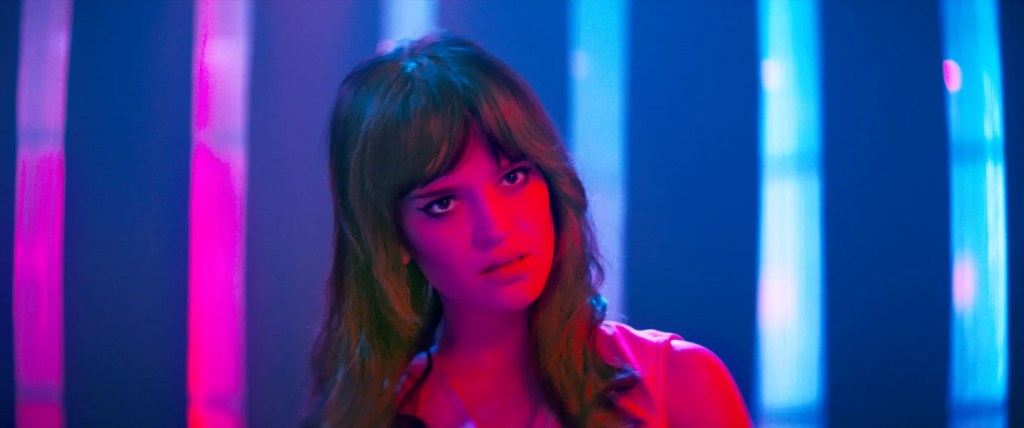
Set in a dark dystopian landscape of US-occupied Japan, ominous skyscrapers rise from misty clouds of pink and purple and the director’s signature aesthetic is very much intact. A pulsing melodramatic score harmonises with exquisite production design as Refn’s visual storytelling overpowers a quite beguiling premise. Dialogue is bluntly delivered, at times comically so, and the concept of a plot takes a backseat in meandering minimalism, washed away by a slow-cinema arthouse wave of indulgence dashed with sequences of ultra-violence involving a mythical killer known as Leatherman.
With backstories left shrouded in mystery, a dedicated cast fill out quite surface-level characters that all feel a part of, but not central to, the film’s broader vision of complicated father-daughter relationships. Known for her breakout role in TV series Yellowjackets, Sophie Thatcher has delved into horror through Companion, Heretic, and The Boogeyman; in contrast, she brings a composed energy to this part, Refn revelling in bouncing vivid colour off of her cool glare. She’s joined by an array of modellific on-trend actors with Melton, Froseth, and Liu giving very little. Meanwhile, Dougray Scott is giving the most in his brief cameo as a theatrically imagined letch.
With his trademark measured pacing and recurring themes of a sexual nature, Her Private Hell is very unlikely to change the opinions of NWR’s many naysayers; its premiere was met with audience boos and walkouts during the Cannes festival. It’s divisive, bold, and unapologetically him, but if you can forgive a lack of cohesion or story, the fluorescent gloom of his world-building is, as always, to be admired.


