
DVD review: GI Joe: Retaliation
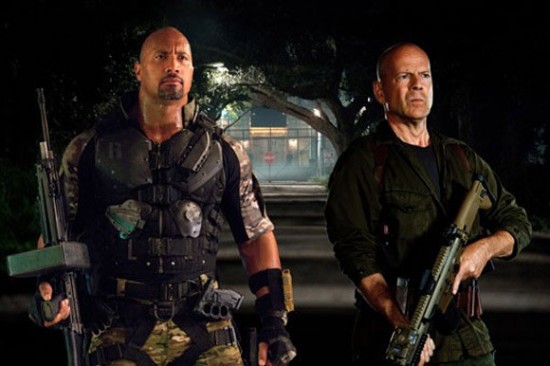
Can you smell what The Rock is cooking? Whatever it is, I think the recipe needs a serious rethink. Following on from 2009’s ‘GI Joe: The Rise of the Cobra’, Channing Tatum’s Duke makes way for Dwayne Johnson’s Roadblock as the new leader of the GI Joes. When nanotechnology is used to disguise villainous Zartan as the President of the United States, Cobra Commander and Storm Shadow are released from their high security chambers and nuclear weapon Zeus is built. It is left to the Joes to put a stop to their destructive plans, calling in the original GI Joe, smugly portrayed by Bruce Willis to help save the day, and the world.
In a plot full of stereotypes and a script full of very little, you’d think it’d be difficult to find something positive to mention, but here it is easy as the visual ambition pays off big time, producing scenes that are great to watch, providing comforting escapism, allowing the viewer to soak up explosions and action sequences without having to think too much. In particular, the ninja mountain fight scene is prominent, along with some impressive CGI city crumbling. For fans of the franchise, I can imagine it would be satisfying with a massive host of characters and nods to the series but as an action sci-fi flick it is nothing out of the ordinary.
Losing Joseph Gordon-Levitt and Christopher Ecclestone from the original, the Hollywood sequel draft-ins include Dwayne Johnson and Bruce Willis. Johnson’s comic patter is a perfect match for co-star Tatum, their cringe worthy dialogue like verbal ping pong, but where neither player quite manages to get the ball over the net. Bruce Willis struts into the story halfway through, excellently playing Bruce Willis playing General Joseph Colton, with trademark cocky glances and awful one-liners, looking as though he feels he is doing the picture a favour in gracing it with his presence.
If you ignore the patchy narrative, the latest instalment in the ‘GI Joe’ franchise provides an enjoyable enough 90 minutes, boasting nicely choreographed fights and striking cinematography. Achieving box office success, it has its draws and to the cult following it will stand as a worthy addition to a series which looks likely to continue, but to the average moviegoer it serves as nothing more than a bit of mindless fun.
See the trailer:
DVD review: Stoker
Even from the title, there is an obvious gothic reference and these continue throughout South Korean director Park Chan-Wook’s first move into English speaking cinema with ‘Stoker’, a coming-of-age psychological thriller. Starring Mia Wasikowska as India Stoker, a misfit teenager, coming to terms with losing her father, whilst struggling to connect with her manipulative mother, immaculately played by Nicole Kidman. Once the mysterious uncle, Charlie (Matthew Goode) arrives on the scene at his brother’s funeral and then moves into the family home, the family dynamic gradually falls apart, descending to darkness.
DVD review: The Battle of the Sexes
‘The Battle of the Sexes’ looks at the women’s liberation movement in the 1970s, focussing on tennis and the conflicts on and off the court of Billie Jean King. This insightful documentary is named after the series of tennis matches involving ‘chauvinist pig’ Bobby Riggs who at the age of 55, claimed that he could easily defeat any female professional as he believed the female side of the sport was far inferior. When he issued an open challenge to any woman who wished to take him on, all eyes turned to Billie Jean King who was a pioneer at that time.
As the title suggests, this contest was developed by the media not just as a tennis match, but a battle between men and women, and the documentary uses this aspect of the marketing well, giving the archive footage a boxing promotion vibe which brings striking visuals and laughs, particularly during ridiculous Riggs segments. This poses the fascinating question of whether he really was the sexist fool and compulsive gambler he seemed to be or was it all an act? Was he in fact an intelligent businessman, carefully plotting to make money from his bold outbursts? Either way, his actions led to a spectacle which advertised the sport to millions and arguably put tennis where it is today. The match itself was set up as if it was a Rocky Balboa duel, with use of extreme close ups, slow-mo sequences and a dramatic score. Though being a documentary, the outcome played out years in the past long predetermined therefore the footage drags at times, failing to achieve the intended suspense.
At this time off the court, Billie Jean King and the other key figures of the women’s game were fighting another battle as they were dissatisfied with the smaller prize money awarded compared with the amounts dished out in the males game. Dubbed the ‘Original 9’, they refused to take part in the tour and in turn bravely set up a tour of their own, the ‘Virginia Slims Circuit’, each playing for only one dollar apiece. This debate is carried out mostly through the talking heads of BJK, Virginia Wade, Margaret Court amongst others, and offers a nice balance to the film, providing a tidy structure and a steady pace.
In the aftermath of the contest between King and Riggs which is the built up finale of the piece, there is a neat summary involving the players of the modern era including Maria Sharapova and the Williams sisters which aids in showing the impact Billie Jean King has had on the game, and on woman’s sport in general. The only problem I have is that although a lot of ground is covered, the character study of Billie Jean King herself is only glossed over. Perhaps as she was not only the star but also one of the people involved in the making of the film, details of her mysterious personal life was held back. The issues of her marriage and her sexuality are merely touched upon, but are not investigated fully, which in fairness may not be of relevance to the key subject matter but would offer a greater understanding of the human being and her relentless courage. Despite not being as hard hitting as King herself, ‘The Battle of the Sexes’ is an eye opening historical account, executed with style.
See the trailer:
DVD review: Broken City
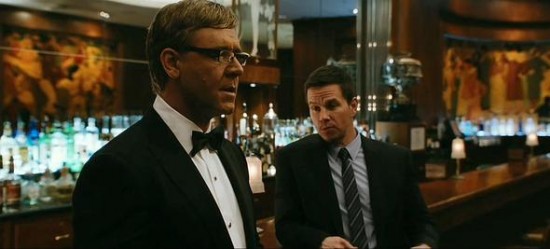
‘Broken City’ is a political crime thriller, starring Mark Wahlberg as ex-cop turned private investigator Billy Taggart and Russell Crowe as Mayor Nicholas Hostetler. When Taggart is in court, set to be imprisoned for the murder of a New York thug, the Mayor pulls some strings to get him off the hook. Seven years later, with an election looming, it’s payback time when the Mayor asks Taggart to track his wife as he suspects she is having an affair. This leads to more than we as an audience, and Taggart, are first led to believe, uncovering secrets and embroiling Taggart in Hostetler’s murky feuds, both politically and on a personal level.
Nothing about ‘Broken City’ is original, each character flat and one dimensional, picked from the bargain bucket of film stereotypes and thrown together in a tired plot; the beaten down ex-cop with an alcohol problem, the crooked Mayor, more gangster than politician and the mysterious hard faced wife with a hidden vulnerability. However worn out the concept is, if you see past the ‘movie plot generator’ used to build it, it is a very enjoyable watch and I can think of worse ways to pass a couple of hours. It can be pleasant having the opportunity to sit back and take in the swooping location shots and admire the slick visuals, knowing the narrative will play out steadily where you expect it to, with no nasty surprises.
I think even the stars suspect the predictable nature of the film, and seem to put that to one side and enjoy themselves which is great to see. Mark Wahlberg, who in recent roles seems to be either underplaying the super serious type, see The Fighter, or overplaying the goofball, see Ted, and here he manages to combine the two, portraying the tough guy with a sense of humour, and he is genuinely funny this time. Russell Crowe also seems very much at ease with his part, spouting lines with venom and giving dirty looks, behind the ‘good guy’ persona he flaunts to his voters. The script is fair, dialogue sub-standard but lifted by the performances. Kyle Chandler pops up yet again, perfecting the ‘angry man in suit’ part he seems to picking up in many of the recent releases and Zeta Jones is quietly passable, her screen presence juxtaposing her character’s fear of her husband.
A decent attempt at rejuvenating a well known formula into something current though it falls short, lacking impact. On a brighter note, it’s a joy to watch the two stars give solid performances, sharing a few gripping scenes and aesthetically, it’s an ambitious homage, achieving the noir look it is going for. If the screenplay was as fitting a tribute as the visuals, then it would hold more value. Don’t expect this film to change your life, it won’t even make much of a difference to your week.
See the trailer:
DVD review: Song for Marion
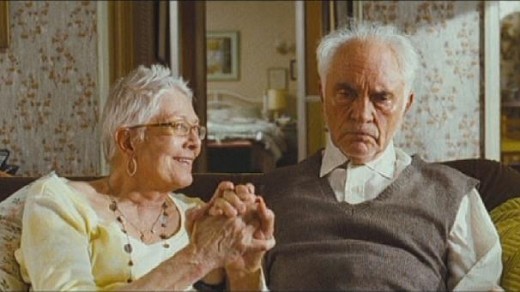
2013 saw the release of two British comedies with the premise of ‘old people singing’ but where I felt Dustin Hoffman’s effort ‘Quartet’ was chock full of pretentious schmaltz, ‘Song for Marion’ seems completely genuine. It is a heartfelt love story directed by Paul Andrew Williams, looking at the relationship between grumpy old man Arthur, expertly played by Terence Stamp, and his dying wife Marion (Vanessa Redgrave), but also his strained relationship with his son (Christopher Eccleston). Set around an aging choir group, affectionately known as ‘The OAPZ’, led by charismatic music teacher Elizabeth (Gemma Arterton), Marion enjoys the final chapter of life as Arthur struggles with the thought of carrying on alone.
As plots go, this doesn’t have an exciting narrative and won’t have you on the edge of your seat. It plods along nicely, but predictably, to the out of tune beats of dodgy cover versions. Where the film lacks in invention and creativity, it makes up for in warmth and the British familiarity is gently comforting. Mixed with the working class elderly backdrop, you can almost smell the mince and tatties and cigarette smoke through the screen. The supporting cast provide light relief from the heartbreak suffered by the central couple and whilst there is great sadness and loss, it gives the plot somewhere to go and prevents it from becoming depressing. The family dynamic is so believable and because of the tightly knit scenes in the family home, giving insight into Arthur and Marion’s everyday routines, an attachment is built with the couple, creating a closeness and a few incredibly touching scenes, but holding your hand along the way.
Terence Stamp and Vanessa Redgrave are outstanding in this. The on screen connection is undeniable and the dialogue is so carefully handled. The intimate scenes that they share provide the highlights of the film, giving off the same impression of longevity in a marriage over an hour that an established soap opera pairing would after building a working relationship over years. By excelling in this manner across the first half of the film, it really assists and props up the second half, Terence Stamp playing Arthur beautifully alone, lost in his surroundings without his companion, so much so that he cannot sleep in their bed at night without her. After Marion’s inevitably sad passing at around the halfway point, it paves the way for excellent professional performances from both Gemma Arterton and Christopher Eccleston, providing spark, each cast member holding their own and rising above the restrictively unimaginative script.
‘Song for Marion’ is a courageous piece of work, providing veteran actors an opportunity to show they’ve still got what it takes to tug on the heartstrings of an audience. They certainly achieve this, particularly Stamp, supplying a multi-layered character and a musical performance that I nearly got up out of my seat to cheer. For a film with the word ‘song’ in the title, there are too few strong musical segments but this somehow doesn’t seem to matter as the strength of the overall acting outweighs the flaws, leaving behind a tender, thoroughly enjoyable working class drama.
See the trailer:
DVD review: Lincoln
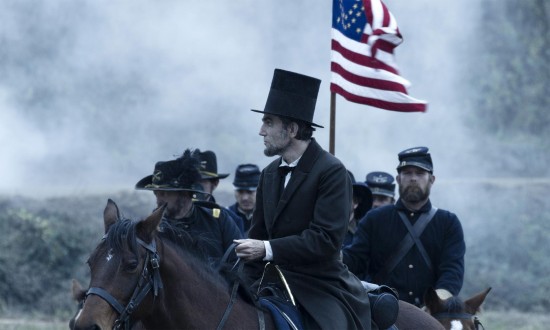
With twelve nominations, Steven Spielberg’s political drama ‘Lincoln’ was the bookies’ favourite in the build up to the 2013 Oscars. The subject matter, the acclaimed director and the fact that it stars two time Academy Award winner Daniel Day-Lewis as America’s greatest historical figure, at first glance, everything about this production screams ‘Oscar Best Picture Winner!’. This film seems to know how big a deal it is, which nearly causes its downfall as it relies on a few colossal performances from acting veterans to rescue it from becoming a bit of a bore.
It has been discussed as a biopic of the 16th President of the United States, the man who ended the civil war and abolished slavery, Abraham Lincoln, though the film is far from a life story. Based on the novel ‘Team of Rivals: The Political Genius of Abraham Lincoln’ by Doris Kearns Goodwin, it focuses in on just four months, in 1865, in which Lincoln fights to pass the 13th Amendment and end slavery. Summed up, it is essentially two and a half hours of men shouting at each other in dark rooms, and for the first hour, it is incredibly slow. The back and forth dialogue is so heavy in spells and when DDL isn’t on screen, you’d be forgiven for wanting to close your eyes for a while until he comes back. The John Williams score lacks imagination and although it serves as a reminder that this is a Spielberg film, it feels at times feels dated and sounds like a regurgitated parody of his earlier work. Spielberg ditches his blockbuster cinematography and opts for stripped down simple shots in poorly lit rooms, involving various bearded men with egos that, for the first hour, seem to blend into one and if you’re not clued in on the history of American politics, it can be difficult to follow the narrative and maintain interest. Luckily with a running time of 150 minutes, it gives itself plenty of time to improve, and it certainly does.
Naming the film after the central character was to me, misleading, as instead of coming away with a real character insight, I am left wanting more, wishing to track down greater detail of who the real man was behind the political persona. Where the film rips through this barrier and offers a look into his family life is when it is at its strongest. Around the halfway mark, there are two scenes in particular which bring this film back from the dead, both showing the Lincoln family dynamic at its most vulnerable. One involving Lincoln verbally sparring with his wife, Mary Todd Lincoln, exceptionally played by Sally Field, and the other with his son played by Joseph Gordon-Levitt who carries out another professional performance in the year he has been in everything. These moments show Lincoln not as President, but as a loving husband and as a grieving father and this is where I believe Daniel Day-Lewis excels and evokes real emotion. He beautifully underplays a big role here and aside from a couple of heartfelt outbursts that make you want to stand up and cheer, he remains reserved for the majority and focuses his performance on the subtle mannerisms of an old man battling to leave his country in a better position than it was when he first took the reins.
I had thought Lincoln would do a lot better at the Oscars, though Day-Lewis deserved his award and it was good to see Field receive a nod. I feel that as a whole, it didn’t fulfil it’s potential and I fear that without the established Hollywood names, it may have been overlooked. It is an extremely grown up film and won’t suit the average movie-goer but still very much worth seeing, though if I am honest, I won’t be in a hurry to go through it again.
See the trailer:
DVD review: Zero Dark Thirty
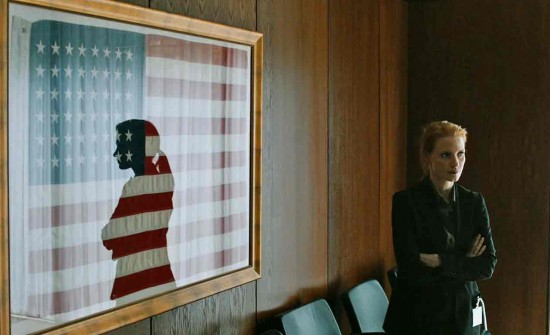
Kathryn Bigelow has done it again. After the major success of Hurt Locker in 2008, she now tells the story of America’s hunt for Osama Bin Laden in the aftermath of 9/11. ‘Zero Dark Thirty’ documents the personal pursuit of CIA officer Maya, played by Jessica Chastain, over the decade it took to track down and kill the world’s most dangerous terrorist. Interesting from beginning to end, and brilliantly captured on screen, this very smart and gruelling picture holds nothing back.
DVD review: Wreck-It Ralph
A Disney animation where when the kids backs are turned, characters interact in their own secret society. It all sounds very Toy Story and with John Lasseter taking an executive producer role, it’s unsurprising. Though the initial concept is arguably borrowed from a past success, Wreck-It Ralph has originality, it’s cleverly written and a lot of fun. The titular Ralph, a bad guy gone good, played by John C Reilly is villain of arcade game Wreck-It Ralph where his sole responsibility is to leave a path of carnage wherever he lays his big clumsy fists, for hero ‘Fix-It Felix Jr’ to clean up his mess and be adored. Ralph is tired and lonely in his job, yearning to be a hero, to be part of something and goes on a mission to win a medal to prove he can do good and be welcomed into a penthouse suite in ‘Niceland’ with all the other good guys.