Interviews

Red Carpet interview: Paddy Considine – ‘My challenges are always with myself.’

English actor Paddy Considine poses for pictures on the red carpet for the world premier of the film 'The World's End' in London's Leicester Square on July 10, 2013. AFP PHOTO/ANDREW COWIE (Photo credit should read ANDREW COWIE/AFP/Getty Images)

From starring in Shane Meadows’ cult classic ‘Dead Man’s Shoes’, appearing in movies such as Hot Fuzz and Pride, to writing and directing the brilliant ‘Tyrannosaur’, multi-talented Paddy Considine has been a key player in the British film scene since the turn of the century.

This year he goes Shakespearean alongside Michael Fassbender and Marion Cotillard to play Macbeth’s best friend Banquo in Justin Kurzel’s anticipated take on the iconic play. At the premiere, I was lucky enough to fire some questions his way…

Continue reading “Red Carpet interview: Paddy Considine – ‘My challenges are always with myself.’”

Features · Interviews

Macbeth Premiere: Interview with Justin Kurzel

FotorCreated

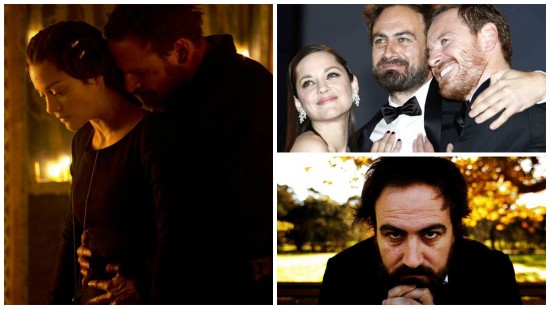
The blood spilled in Macbeth was as deep and red as the carpet at Edinburgh’s star-studded premiere at The Festival Theatre, where crowds gathered to celebrate the release of the latest adaptation of William Shakespeare’s iconic play. In its introduction, Australian director Justin Kurzel jokingly calls his latest work ‘The Scottish Film’ in reference to the well known theatre superstition of never uttering the play’s name, but jokes are nowhere to be found in his bold and brutal retelling of the story.

The highly acclaimed Michael Fassbender stars in the titular role, with Marion Cotillard by his side as the influential Lady Macbeth. The supporting cast includes Paddy Considine, David Thewlis, Sean Harris and Elizabeth Debicki. Their Skye shoot was marred with horrid wind and rain, beating down to give the perfect weather-beaten backdrop for events to unfold. The premiere was much to the contrary as the sun shone on the stars to greet the fans, Fassbender revelling in signing autographs and taking selfies with his Scottish admirers.

I was fortunate enough to have the opportunity to chat to the director of the piece Kurzel, who had an interesting take on the central character, comparing him to Breaking Bad’s Walter White, who is arguably the greatest television anti-hero of the 21st century. Discussing the odd similarity, he said, “I was watching a lot of Breaking Bad to have some freedom away from the torture of the edit and found that, like Macbeth, it is about a man going mad and descending into an evil that he can’t find a way back from.”

Bringing a Shakespeare classic to the big screen is no mean feat and the filmmaker was quick to discuss his reasons for giving it the cinematic treatment.

“It kind of read like a Western when I read the screenplay, and felt really modern. The Scottish setting made it feel very honest. It didn’t feel contrived or as if it was a prisoner to the words. The writers had a new take on the themes of ambition in the play, making it less about control and more about what you do with grief and trauma, especially being a warrior. We found that to be a really fresh and interesting take on the original material.”

He also spoke freely about the universal appeal of Macbeth, and how the story has the longevity to be told again and again without becoming stale.

“I read something the other day that stated that every four hours across the world a production of Macbeth is taking place, so I think already it is the biggest blockbuster around. I think it is whether people are engaged enough to want to see a new one because it carries a lot of baggage. People think if they’ve seen it, or read it, or studied it at school that they’ve done it so I think it’s always about offering up something fresh and new.

For us it’s about placing it back in the time in which it existed, and finding something very human and real in it. I’ve seen it now three times and it’s amazing to me how much Shakespeare keeps on repeating itself but people always want to go back for a second or third time to watch it. I think it has a lot to do with the verse because you don’t always hear or understand the verse the first time so you want to go back and get something new from it each time.”

Macbeth is available on DVD, Blu Ray and on demand.

Interviews

The Road Within Interview: Gren Wells – ‘We’re all weirdos. That’s why Breakfast Club is such a classic.’

TRW 5

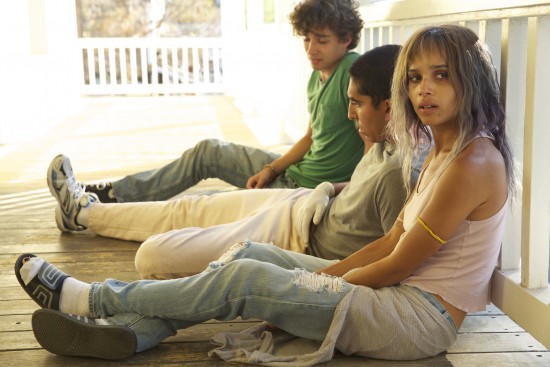
What do you get if you take someone with Tourette’s, an OCD sufferer and an anorexic and put them on a road trip together? You get new film, ‘The Road Within’, written and directed by Gren Wells. Taking on the complex roles of Vincent, Alex and Marie are Robert Sheehan, Dev Patel and Zoë Kravitz, and Gren Wells has kindly agreed to discuss the project, exclusively with Cinema Perspective. This is what she had to say…

Continue reading “The Road Within Interview: Gren Wells – ‘We’re all weirdos. That’s why Breakfast Club is such a classic.’”

Interviews

Hector interview: Sarah Solemani – ‘Peter Mullan is an actor’s actor. He didn’t disappoint’.

Holland Park Pic2-2British actress Sarah Solemani is best known for her roles in BBC comedy programmes ‘Him & Her’ and ‘Bad Education’, and this year she appears at the Edinburgh International Film Festival in ‘Hector’ alongside Peter Mullan and Keith Allen. Directed by Jake Gavin, the film provides insight into the UK’s homeless community, and tells the story of Hector (Mullan) who tracks down his family after years on the streets. I have been fortunate enough to discuss the film with Sarah, and this is what she had to say…

Hector is a beautiful film that boasts the established talent of the brilliant Peter Mullan. What was he like on set and to work with in the tender scenes you have together? 

‘Thanks Garry! Peter Mullan is an actor’s actor. That is, amongst actors, he is considered the best. Best talent, best showbiz stories, best banter etc. Actors want to work with him because they know they’ll learn from him, and that they’ll get a training of sorts. He didn’t disappoint. On set he was relaxed and gentle, and when we weren’t filming we would be smoking in his room talking about Marxism and global politics – a fascination we both share.’

The thought-provoking film is effective in showing both the kindness and cruelty shown towards the homeless community in Britain. How do you feel about how homeless people are perceived in the UK and have your views changed at all following your role?

 ‘I don’t think my views have changed because I’ve always been aware of how fragile certain people are and how easy it is to slip through the net. I suppose the film serves as a reminder that the homeless aren’t just addicts trying to make you feel guilty to fund their habits, which sometimes gets caught in our heads. They often have heartbreaking, eye-popping, epic stories behind them, and could even be considered Job-like heroes if you think about what they’ve been through and survived. Perhaps because we physically look down on them, on the pavements or shop doorways there is a sense of them being lower, amongst the dirt and the stench, but what the film does in putting a homeless person as the protagonist is elevate them to a different status which I think is missing from common consciousness.’

solemani

 When Hector is at his lowest, the introduction of your character Sara is a breath of fresh air to him, and to the film. What was the process like in bringing light to what at that point was a dark part of the film?

 ‘I didn’t really approach it in terms of light and dark, though I’m glad that is what was perceived. I met people who worked in the social system; support workers, social workers, volunteers etc. and tried to get under their skin a bit. What struck me was the hours a lot of these people work; the pressures, the low pay, the levels of paper work so there was a ‘busyness’ to her that helped me avoid sentimentality. A practicality – she wants to help Hector because that’s her job and there’s a process. Rather than do a Mother Theresa number I wanted her to always be on the move, rushing about from one person to the other so that when she does take a breath for Hector, we realise there is a special bond there.’

 I have read that a Bad Education film is in the works. Can you tell us a little about that?

 ‘I could but I might not live to see another day! Ok, don’t tell anyone but it’s all shot, it’s fantastically funny and it should be out very very soon…’

Him and Her

Finally, I am a huge fan of Him & Her and thought you were excellent in it. Are there any plans to do another series or can we expect to see a big screen outing for Steve & Becky? If there was to be a film version, what would be your dream plot?

‘Thank you! I’d love to do the film. Becky announced her pregnancy in the last ep of the last series so I’d love to see how they’d cope with another little addition to their slobby family!’

Interviews

Director interview: Morgan Matthews – ‘I want to be creatively challenged and try all the different forms of storytelling, whether it’s documentary or fiction’.

morganmatthews

Inspired by his own film Beautiful Young Minds, British filmmaker Morgan Matthews directs ‘X+Y’, a story of a young boy with autism who has a gift for mathematics. The cast includes Asa Butterfield, Rafe Spall, Eddie Marsan and Sally Hawkins. It screened at Glasgow Film Festival and I was fortunate enough to speak to Morgan Matthews about the project…

Coming from a career in documentary filmmaking, why was this the right time for your first foray into feature fiction?

I’ve made a lot of documentaries and have done so in differing styles but at the same time felt that I was making them in quite a similar way. I want to be creatively challenged every time I make a film and try all the different forms of storytelling, and whether it’s documentary or fiction you’re still telling a story. In some ways there are a lot of similarities.

Continue reading “Director interview: Morgan Matthews – ‘I want to be creatively challenged and try all the different forms of storytelling, whether it’s documentary or fiction’.”

Interviews

Director interview: Hans Petter Moland – ‘I see humour in a lot of places, when others would think it is inappropriate’.

still-of-hans-petter-moland-in-in-order-of-disappearance-(2014)-large-picture
At the Edinburgh International Film Festival, I saw Hans Petter Moland’s new film and was lucky enough to get the opportunity to ask him some questions. The Norwegian revenge thriller stars Stellan Skarsgård who is best known in the UK for his roles in films such as Good Will Hunting, The Girl with the Dragon Tattoo and The Avengers. ‘In Order of Disappearance’ is released on 12th September 2014.

You are known for your collaborations with Swedish actor Stellan Skarsgård. What is it about him that makes him so good to work with?

‘Well he’s probably one of the best actors in the world so it’s not terribly hard to go back to him each time. He’s a wonderful actor and I’m sure other directors who’ve worked with him would say the same. He not only gets it but he is really good at contributing to a process so he’s a lot of fun to work with.’

Continue reading “Director interview: Hans Petter Moland – ‘I see humour in a lot of places, when others would think it is inappropriate’.”

Interviews

Director interview: Craig McKenna – ‘It was the most satisfying feeling to pull it off. I would gladly do it again and again.’

whenthetide

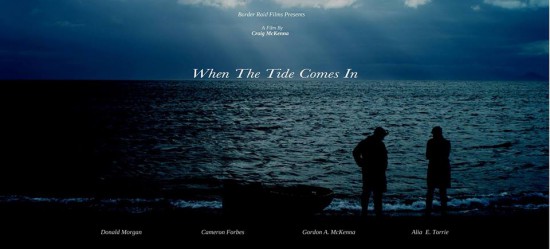
At Cinema Perspective, it is vital to not only provide the latest news and reviews from the mainstream and the indie but to remember how important locally-made films are, whether they are shorts or feature length. Edinburgh-based filmmaker Craig McKenna has been working tirelessly on his new short film ‘When The Tide Comes In’ and is building an online presence for the project through social media updates and teaser trailers. You can find more information on the Border Raid Films Facebook page but before that, he has agreed to answer a few questions about his latest film and the process involved…

Firstly, we’ve seen the teasers but can you give us a short overview of ‘When The Tide Comes In’ and how the idea for it was formed initially?
“When The Tide Comes In” is the story of two adopted brothers Aubrey and Gedys who have to overcome their differences to fulfil their father’s dying wish. It is set in rural Scotland in 1936, and deals with family ties, loyalty and conflicts of the heart, when the right thing to do is sometimes the most painful.
The film stars Donald Morgan, Cameron Forbes, Gordon A. McKenna and Alia E. Torrie.
Initially, the idea came to me while driving – I know, that sounds dangerous! I seem to get a lot of ideas on long stretches of road whilst listening to classical music. I remember it being a 50 mile drive so I had plenty time to allow the idea to ferment.
It must have been around November 2013, a competition came up looking for submissions of 5-minute shorts on the topic of “Family Business” and I started developing the idea to the brief. I really wanted to do something ethereal, and moving, far removed from the mainstream. So I wrote about two sons staying with their dying father until the end. But 5 minutes just didn’t feel right – it needed more room to breathe. I made the decision not to enter the competition, and instead further develop this idea into something more complete. Two weeks later, the first draft of “When The Tide Comes In” was ready.’
How did the experience of making the film differ from previous films you have been involved in?
‘There are definitely that moment after writing a script when you stop and think, “how the hell am I going to shoot this?!”. This was one of those. In terms of filmmaking, “When The Tide Comes In” is certainly the most ambitious production to date.
The first big change was that from the start I wanted this to be a period film. With that in mind, you approach things very differently, because you have to consider the audience buying into the time and setting. It’s great because you can be so articulate in creating the world your story and characters exist in. The research and referencing was the biggest undertaking and really enjoyable.
Being period accurate was vital, because if you settle for less, I kinda think you end up with a half-assed film. My partner Alia (in addition to her performance) has a fantastic eye for detail, history and a flare for colour, so when I asked her to oversee Costume, I already knew how shrewd she would be and not settle for anything less. To be working with her like this really raised my game as Designer, and in turn it brought out the best in each other. I really felt we were just very on top of the films subtext, tone and its authenticity.
Working with DoP Alan C. McLaughlin was a real education for me too, primarily because he got me to start looking at things in terms of ‘movements ‘ rather than shots. It really opened up possibilities. With this in mind, we chose to used a Prosup Jib pretty exclusively so that we had the flexibility to shoot those movements. It was a totally fresh approach to me.
However, Perhaps the most ambitious part of the film’s was the second block of filming. There was so much hanging on the final scene’s emotional conclusion, which involved a boat and a particularly choppy Irish Sea. (Uh-huh..raised eyebrows) There were just so many variables to consider, it was pretty insane. Then we found out that due to changing weather we were really only going to get one day to shoot those scenes ….
But it was just the most satisfying feeling of achievement to pull it off. I would gladly do it again and again.’

10342461_1580037915561705_4296290792615236833_n

I can see that you had an extensive crew working on the film. Do you view filmmaking as the development of the director’s singular vision or is it very much a collaborative process? Or is it a bit of both?
‘You know, that’s a very difficult question. Personally I think it comes down to the individual director. There are those who seem to have every decision made in their head before they get anyone else involved, everything is predetermined and filmmaking becomes a process of carrying out a series of commands. I know that is an extreme, but it does exist. It’s not really my way. Having a definitive vision is a real strength but I also like to think of myself as being open to trying out new things and exploring possibilities. Start with the script and work from there. The people you bring into the production process are such a great resource and good people can bring so much to the table.
For this film, I certainly felt that being open to ideas and making informed decisions was far more rewarding. While the final decisions were down to me, it was the discussions with cast, the considerations of costume design and the possibilities of cinematography etc. that really brought the film together. I don’t think I could ever regard this film as only one man’s triumph.’
Now that you’ve honed your skills in short filmmaking, are there plans in the pipeline to venture to feature length?
‘Oh, I would very much love to. There are many stories I’d love to develop. The important decision is whether to go long-form with them, and how to do them justice. But yes, there are plans in progress. Fingers crossed.’
From your social media updates, I notice that your father features as one of the actors in the film? How did this come about and what was it like directing a member of your family?
‘Yes that’s quite right. My Dad plays Morley the father of Aubrey and Gedys. In many ways he is perhaps the most pivotal character of the film.
When I think about it, it was really my Dad, who got me interested in storytelling and film as a child, and I think he would have loved to pursue a career in the arts himself. For Morley, Dad had always been a consideration for the part, but I wasn’t sure how he would feel about it if cast. I remember that during the auditions there was strong interest in the roles of Aubrey and Gedys, but there were only a couple for Morley. It was a very uncertain time, but after chatting about it with colleagues I started seeing my Dad more and more playing the part.
Since the last film, I’d really given a lot of thought into directing performance. It’s important to understand that actors, like all of us, work and learn differently. Some work with description, others with imagery or music. My Dad currently works as a home carer. When we read the script together, he seemed to think through the scenes and character by referencing it to real people and life situations he had witnessed, particularly about the sick and elderly. It helped him visualise it and explore it in his own way.
Sadly, he couldn’t make the rehearsals, so he and I didn’t get much time to really go through performance until the first morning of the shoot. I was dead nervous, I can tell you! When the camera started to roll, Dad’s performance started with this “death rattle”…and it completely took us all by surprise.
Lastly, thank you for your time, and best of luck with the film!
My pleasure, thank you for having me.
See the trailer:
Interviews

Director interview: Jamie Adams – ‘A surrogate family emerges almost organically – you can’t escape it at Christmas!’

awct

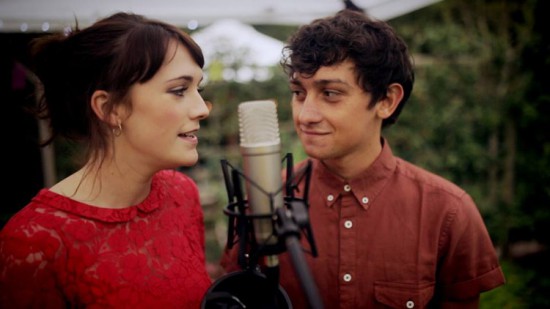
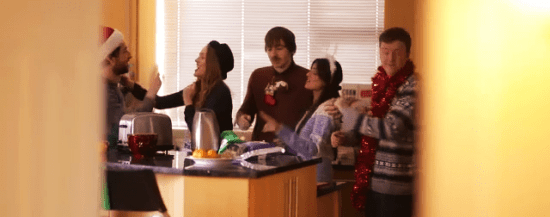
At the 2014 Glasgow Film Festival, I was lucky enough to be introduced to the work of writer director Jamie Adams (pictured above right) when I watched indie gem ‘Benny & Jolene’. His latest feature ‘A Wonderful Christmas Time’, starring Laura Haddock and Dylan Edwards (pictured above left and middle), follows similar themes and Jamie Adams kindly agreed to discuss these with me. See it on-demand from Monday 24th November.

It’s exciting to see that films can now avoid the standard route of distribution, and ‘A Wonderful Christmas Time’ is to be available on demand first and in cinemas after. How did this decision come about and do you see it happening more in future?

‘These are digital new wave movies so it makes complete sense that our path would lead to on-demand platforms in the first instance, where a good percentage of our audience will discover the movie. Hopefully it will be backed by decent word of mouth and positivity and the movie heads into selected indie cinemas. This system has been working brilliantly in America this year especially and so to bring this idea to the table in the UK and to be the first to distribute a movie this way in the UK is exciting, and also what we’re about. For our next movie we’re looking at BitTorrent bundles for example. I love going to the cinema and believe it’s where movies come alive but that doesn’t mean both platforms can’t work together and compliment one another, to co exist and actually support one another.’

Your new film clearly looks at the Christmas spell through a perspective we are not used to seeing on-screen, highlighting the loneliness that some face at the time of year. Personally, are you a festive-fanatic or are you a bit of a scrooge?

‘I can see there’s a loneliness there sure, but I think that’s because there’s a pressure to spend Christmas with your family and friends – for it to be a collective experience as much as possible. It’s also the time of year where we take stock as individuals and reflect on where we are in our lives and where we want to be so even though we tend to be surrounded by people, close relatives, loved ones, we are all essentially more alone than ever as this introspection seeps into our thoughts. Having said all that family is important to me, it’s the time of year geared toward bringing family to the fore and as such I love Christmas, I have three children and a beautiful wife that get incredibly excited about the festive season. I think in the movie we see that a surrogate family emerges almost organically – you can’t escape it at Christmas, somehow a family environment, and all that entails will emerge somehow! It’s the domestic detail of Christmas and the tension all the traditions bring to a family environment makes me smile! So much opportunity for awkward moments between relatives that hardly talk to one another all year!’

From the films you have written and directed to date, you have pulled in an impressive cast for both, having the brilliant Craig Roberts in ‘Benny & Jolene’ and Laura Haddock in ‘A Wonderful Christmas Time’. Tell us a little about the casting and how these big names got involved…

‘Craig (Roberts) noticed that this filmmaker from South Wales was making an improv comedy and that Charlotte Ritchie and Rosamund Hanson had got involved. He got his agent to get a message to me that he wanted in – I sent him a tweet and that was that he was in! Charlotte was the first on board she contacted me via Facebook to say she really enjoyed this short film I’d made with a mutual friend of ours and that she’d be up for making a short together. I then built the story around Charlotte being this Laura Marling type and I contacted Rosamund via Facebook and she called me while I was at work as a Park Attendant (!) We talked about how we’d be in a motor-home travelling into North Wales to a music festival and we’d improv all the way there and back and she loved the idea!

With ‘…Christmas Time’ I saw Laura (Haddock) in Inbetweeners Movie and thought she was fantastic – the best thing about what is an awesome movie. I found out who her agent was and sent him a long email explaining who I was and that I needed to chat with Laura about making a movie. Again it was the five day improv idea that caught her imagination and after a two hour conversation at Soho Theatre she was in! Actually this is how I discover the actors I would love to work with – I see them in a movie or TV show or play and “fall for them” in a ‘I really want to create a character with them type of feeling ‘… That sounds a bit rude! It’s true though that making indie movies is incredibly difficult so you have to be excited about creating characters and stories with your actors – especially with improvisation. Then I watch them in an interview situation on YouTube, so Laura on a red carpet somewhere being interviewed, and I’ll be closer to knowing whether or not they can improv in the way I’ll need them to. Sometimes it’s award speeches like Sean Harris at last years Baftas – what a speech – so natural and funny – so I’m currently chasing him! To make a movie with him is high on the agenda. Then I contact them via any means necessary that falls short of stalking! Digital platforms such as Facebook and Twitter have really been such a useful communication took for these movies. It’s all about how you approach people though – it’s not as simple as messaging someone and they’ll jump at being in your movie! Agents are really helpful too and they want their clients to be involved in a range of projects and so something like the experience we offer is exciting to a lot of actors. There are so many factors with casting, especially on indie pictures as you don’t have the finance to entice. Your picture isn’t going to raise profile necessarily and for me I don’t have scripts.
10268705_798103010240524_3809854259845468718_n

I have stories and character sketches and now I have a few movies to show as examples of my work – it’s a real passion thing – you have to work hard at setting up the projects in such a way that you can juggle actors other commitments so that come your shoot dates they can all be there with you and in the moment. Sometimes you’ll lose one or two along the way because you simply can’t keep all the balls in the air at once – there are too many variables – so I have yet to work with Tuppence Middleton, Sally Phillips, and Alexandra Roach all of whom I’ve come very close to working with on various movies but in the end it hasn’t worked out. Nine times out of ten if you believe in your movie and share that enthusiasm, communicate that enthusiasm using the appropriate form of communication for that particular actor and it’s something they are interested in doing. It doesn’t really matter that there’s no money or profile raising involved – for most actors it’s about being involved in a movie they believe in. That could be as much about the challenge of making it as it is about the final movie. That said having your best work at hand to present as an example of what you do is helpful, enthusiasm will get you through the door but it’s your previous work and the way in which you communicate your passion for the story /character that will attach your chosen star(s)!’

The dialogue in both films has succeeded in coming across very naturally, and the actors have gelled well to the improvisational approach. How much of ‘A Wonderful Christmas Time’ is scripted and how much comes in during production process?

‘Thank you firstly! We work hard on achieving a sense of naturalism, especially with the dialogue, which is created over the course of production. In the scriptment (a detailed scene by scene account of the film) there are a few lines of dialogue here and there to give a sense of how a character might talk. I discuss the characters with the actors and these discussions feed into the creation of the characters and how they talk is a part of this. During the shooting of the scenes they reveal their characters in the moment and between each take I might say I liked this or that or didn’t like this or that and the actors readjust accordingly. We go again and again until it’s as good as it can be and I have what I need and then in the edit we make choices on what pieces of dialogue to use where – so in a way we are writing right through from inception of the idea through to the edit and sound mix.’

Following on from the last question, do you have tight storyboards and a polished treatment laid out before you start shooting, or do you let the improvisation take over to tweak and transform parts of the story as you go?

‘Storyboards are too rigid and too restricting for me as are treatments in their most polished form. I work hard on creating and writing a good story with great characters full of potential and strong relationships to explore. I begin conversations with the actors – sometimes about the characters – sometimes just about things that are interesting me leading up to the shoot. Then we shoot, and it’s here that I’m guiding the improvisation, always tweaking and leading the talent around me into the unknown and it’s there that we find the gold. Each take is different and builds on the last and  as long as we are staying true to the relationships we are moving through our acts and gathering the material to create the story.

It’s there that the writing takes place and I truly believe the best cinema allows for freedom of expression in the first instance and that you have to be present during the shoot and in the edit to have the confidence in the talent to express themselves – and to be open to the film presenting itself. It’s difficult to put into words but anyone that’s shot a film will recognise that moment in the edit where the film they were making becomes the film they have made. It’s at this moment that you have to stay strong and react in a positive way to this film that isn’t the film you imagined for years during its formation. That’s where improvisation led movies come into their own because you are always aware that the film will constantly shift and struggle. In being prepared for that I know I’m in the best position to recognise the version of the movie that will play the best with our target audiences, which remain forward thinking, honest and sincere, hopeless romantics with a great record collection and an even better sense of humour!’

985236_orig

From my research, I know you started out as an editor and have documentary experience before you made your own features. Have you always wanted to direct or did the appetite for this come through being involved in previous projects?

‘Since I made my first movie on super VHS back when I was fourteen years old in 1994, I have been a filmmaker, director. I trained under a great documentary maker at Royal Holloway University – Gideon Koppel who made the brilliant Sleep Furiously recently – and I recognised early on that I gravitated to the work of the great improvisers. The French New Wave, Mike Leigh, the 1970’s independent cinema gang of Scorsese, De Palma, Coppola, Altman and more. I mean Woody Allen writes his scripts very quickly in an almost stream of consciousness and encourages the actors to improvise all the time. His camera may be fixed and behaves traditionally but his actors are free to express themselves and that’s why they get award season recognition because they embrace the freedom.

Improvisation to me doesn’t mean shooting without a script – it means being prepared to live in the moment and make choices in the present not the past. I have worked with some of the best editors we have in Britain and learned so much about pace and rhythm and keeping your audience at the forefront of your mind at all times. This sense of confidence in the edit comes from many years seeing movies emerge as an editor. I’ve also worked as a lecturer in film and as a parks attendant, a shelf stacker in a supermarket, a finance assistant at a holiday park, a fruit and veg shop assistant and more, which have all influenced my approach to film making!’

I’ve seen ‘B&J’ and ‘AWCT’ described as the first two parts of the Jolene Film’s modern romance trilogy. With the former looking at the music industry and the latter at Christmas, can you provide us with any exclusive insight as to the direction of the third?

‘Well it’s called ‘Black Mountain Poets’ so we can assume we’re looking at the world of poetry and poets in some way and I can say that it looks at relationships and romance. I can also say that we have the best cast with Alice Lowe, Dolly Wells and Tom Cullen, amongst others including Josie Long making her feature film debut. Dolly and Alice play sisters Claire and Lisa and Tom Cullen plays Richard, a poet that hasn’t written anything decent for seven years!’

My review – ‘A Wonderful Christmas Time’