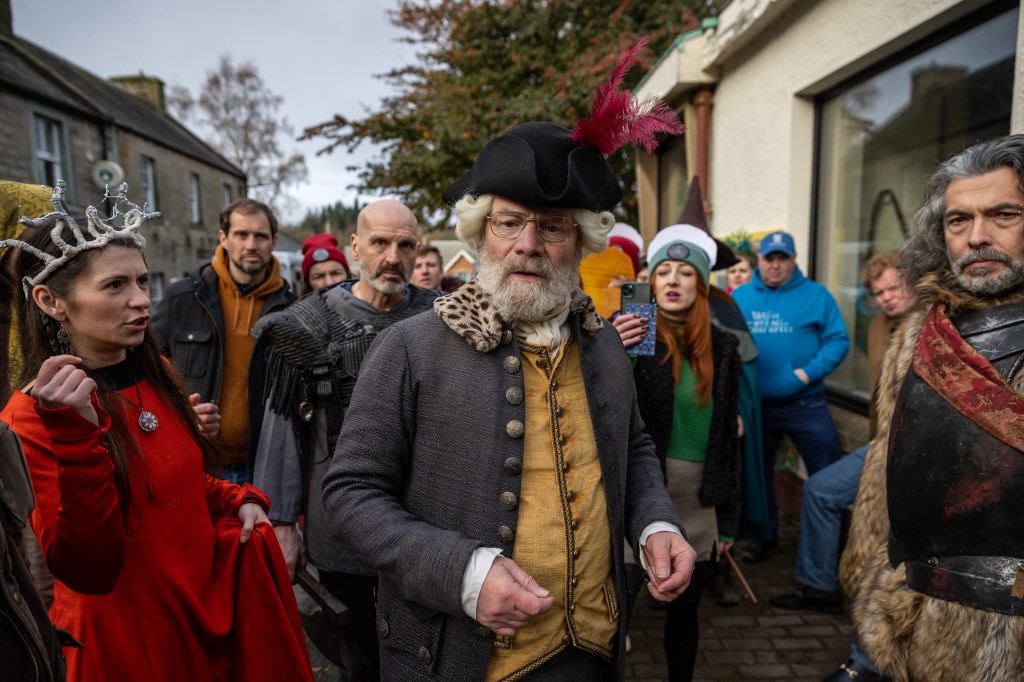
At what point does entertainment tourism overshadow the real history and legacy of a location? Writer and director Sean Dunn explores this very topical idea through the lens of black comedy in his hotly-anticipated debut feature, The Fall of Sir Douglas Weatherford. Taking place on the outskirts of Edinburgh, the plot sees keen historian and tour guide Kenneth (Peter Mullan) become increasingly frustrated as his local village becomes the setting for a new fantasy television series. Note that I know Dunn personally and was lucky enough to have a conversation with him about the film ahead of its UK premiere at Glasgow Film Festival 2026…
It’s been a few years since we last spoke and I remember you telling me you were trying to get your first feature made. How does it feel now to be putting it out into the world and how did the premiere go in Rotterdam?
Rotterdam went well. We had Peter [Mullan] over there for the premiere, and they had it on an IMAX screen. I don’t know why as we never shot an IMAX but it was huge, like the biggest screen I’ve ever seen. It was quite cool to see it like that and the audience seemed pretty engaged. That’s all you can really ask for, you know what I mean
Overall, it’s a long process. We shot in late 23, in November and December then did pickups the following year. It feels good to get out there, man. It was long though – the writing, getting funding for it and all that. It’s not easy but good to finally have a premiere and move on from it.
Edinburgh has become such a film and TV hotspot in recent years with Marvel, Fast & Furious, Dept Q, and of course the Harry Potter lore and having Outlander shot nearby. Obviously your script has some social commentary on that – having grown up here but now living in New York, how do you feel about your home city changing in this way?
It was a bit ironic that we came to Balerno to shoot and there were moments where people probably thought we were intruding on their lives, like Kenneth feels in the film. We took over their high street for a while. Growing up in Edinburgh, as you know, is like the city is a museum in a way. It’s very beautiful and historically important, but you see the Harry Potter tours happening and it’s like fucking Disneyland or something like that. But it’s actually like a living, breathing city that people live in. In my mind there’s more interesting historical points that people could maybe be drawn towards instead of the fantasy or whatever…like the Thomas Riddle gravestone thing. He’s a real man with a real story but that’s completely gone now. Nobody is interested in that detail.
You mentioned Marvel and I think with that and Outlander, we’re like a beautiful backdrop to someone else’s story. We take great pride in that and it is good for Scotland’s economy and putting us on the world’s stage…but at the same time, it doesn’t dig very deep.
I’ve definitely been guilty of going to certain places purely because of what has been filmed there. I enjoyed hearing little gripes from Kenneth like where he says ‘it’s not a movie, it’s a film’…in some way, did you use him as a bit of a vehicle for your own annoyances?
I think there’s a little bit of me in there, but I’m not that closely aligned to him. Peter actually came up with that line and he improvised a lot! He often came up with much better things than I wrote – I guess Kenneth is a bit of a snob, isn’t he? He’s on his high horse and I think in Scotland, we like being the underdogs. We think we’re more moral or egalitarian than the English as if we weren’t involved in the same atrocities. Some of that is probably true, but we did participate in that shit as well. That was sort of my thesis on where I was coming from with the film. I wanted to take the mick out of fandom, but I hope it doesn’t come across as mean-spirited.
That aspect of the script is quite lighthearted I would say and it’s great that you have Peter Mullan as the lead because he himself has been a part of these fantasy shows. He straddles that space so well between big budget productions and little indies like this. Aside from his brilliant acting, what did his wealth of experience give you as a director making your first feature?
Peter’s just very grounded. First of all, he’s a filmmaker, you know what I mean. He’s a good filmmaker and he’s had a lot of success. He understood it on that level so as a first time director, It was definitely helpful. He was patient with me and very collaborative. He understood the role of the director so would give me space as well…but he was demanding, in a good way.
He challenged me daily, about Kenneth; how he thinks, how he would behave and when he felt it was kind of inauthentic, he had ideas of how to make it true to the character. An example of that is in the scene where Kenneth elbows the security guy. In the script he actually punched him but Peter argued that it should be accidental. At first I wasn’t too sure but I trusted him with it and in the edit, it became clear that it was the right call.
What was the biggest challenge you faced during the shoot?
Well, I think it was a very ambitious script actually. I didn’t really appreciate that, going into it. You don’t always think about how much the things cost, or how long it takes to shoot some scenes with a whole crew – you don’t think of the logistics side of it. We also had to create the sense of a high-budget TV show with costumes and lots of locations. These sorts of things cause challenges but ultimately you have to adapt. This is why we did pickups a year later because we didn’t really have an ending that worked. You have to rediscover the film during the edit in a way.
A director once told me that the key part of his job was decision-making and in a way, having a low-budget means you have less things to choose between which made his job easier. That always struck me as a smart way to look at directing but not everyone would agree. What’s your take on that?
I see the logic and if you have constraints, this can maybe inspire creativity. I suppose it depends on the type of film you’re making. If you’re making an intimate drama and have to be close to the characters, this might be easier…but if your film is plot-driven and you have to hit certain beats to keep a momentum going, then I think it’d be useful to have more options.
You had David Gallego as your cinematographer who has worked on great films such as Rebel Ridge, Embrace of the Serpent, and I’m Not a Witch. How was your collaboration with him in creating the look you wanted your film to have?
I’d seen David’s work and was impressed by his technical ability. We didn’t have lots of time together before the shoot and it’s a different kind of film to what he’s done in the past I think. What was the most important thing I’d say, and what David excels at, is understanding where the main character is in every scene. Understanding motivation and emotion, and this comes even above visuals for him I think. He’s very interested in story and character and he was a good collaborator. With his huge experience, we felt like we were in safe hands.
Speaking of the main character, there’s an element of psychological decline with Kenneth in the way you explore his grief. Was it tricky to have this melancholic tone but also keeping the tone of a comedy?
This was a challenge, and more so for a feature compared to my shorts in that sense. I think it goes back to the writing. I had a lot of fun and a lot of my ideas were quite absurd with adults in costumes and all the rest of it. I wanted to satirise that so a dark comedy was the right vehicle for that story…but you want the pathos too because he’s a grieving man. There’s the spooky elements too with him seeing visions of Weatherford. There’s a lot going on genre-wise but I wanted audiences to go on a journey with him.
You mentioned moving on from the film earlier. What do you think that looks like for you now that you’ve got your first feature under your belt?
I’ve got a couple of scripts and I guess the commonality is masculinity in crisis. Alexander Payne’s films were an inspiration for this one a wee bit, and I’m kind of drawn to that. They deal in the absurd but how do you get those films made? You write something and hope.
Would you ever write something and hand it over to someone else or do you now see yourself as a writer AND a director?
I would do that. I think because mostly you’re writing, you see yourself as a writer. Nobody really gets to direct very often unless you’re like Lanthimos or someone and making so many films but he doesn’t write his own work all the time.. I love writing scripts so if there was an opportunity to write something for somebody, or adapt something for somebody to direct, I’d do it but I think when you come up with something quite specific, you want to see it through the whole process.
If you had unlimited options and could work with anyone, alive or dead, who would it be?
That’s a good one, man, and it’s something I’ve never thought about actually. I think Jesse Plemons is great. He’s really good even in that sort of cameo in Civil War. I thought it was excellent. Who else? Fuck, alive or dead, I’d go Brando.
The Fall of Sir Douglas Weatherford will have its UK premiere on 4th March at Glasgow Film Festival

 Cinema Perspective