
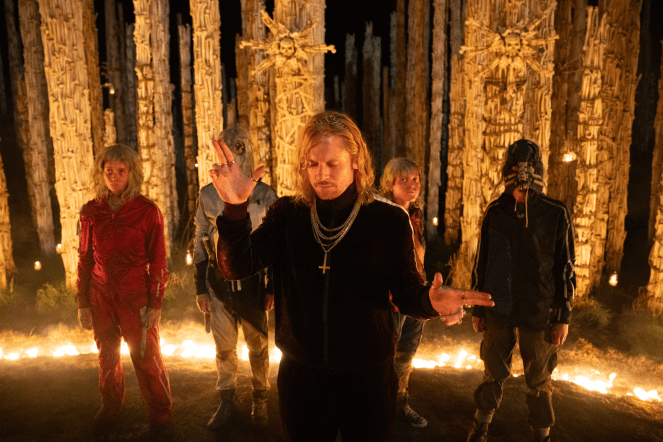
It’s been less than a year since this post-apocalyptic zombie series was revived by Danny Boyle and Alex Garland, and Nia DaCosta has taken on the directorial duties for the latest instalment. Bridging the gap between the beginning and end of this sequel trilogy, 28 Years Later: The Bone Temple picks up directly where the last one left off. Reeling from the tragic death of his mother, young Spike (Alfie Williams) has been taken under the wing of cult leader Jimmy Crystal (Jack O’Connell) and his gang of followers. Meanwhile, Dr Ian Kelson (Ralph Fiennes) forms an unlikely friendship with “Samson” (Chi Lewis-Parry) who has been infected by the ‘rage virus’.
Less concerned with the big picture storytelling around how the outbreak is impacting the world as a whole, this outing presents studies of two pivotal characters within the broken Britain that screenwriter Alex Garland has crafted. Even in this ravaged landscape, science and religion butt heads with Kelson and Crystal representing opposite ideas of how we might try to survive such desperate circumstances; latching on to any kind of faith or community to cope or using data and logic to work towards a cure. Of course, there are doses of exhilarating action to supplement this more thought-provoking narrative. DaCosta pulls no punches with this aspect of the filmmaking, maintaining the signature grainy handheld style within moments of terror, but bringing her own horror flair to some excellent scenes of extreme violence.
Reprising what was largely a supporting part previously, Ralph Fiennes is given the opportunity to flesh out the complex and mysterious role of Dr Ian Kelson. We get a strong sense of his life before the epidemic through the film’s brilliant soundtrack choices, and this brings a deep melancholy to what from the outside appears to be utter madness. As his and Jimmy’s paths inevitably collide, their moments together are full of suspense but laced with the darkest streak of humour. Kitted out in a purple velour tracksuit with bling topped with a blond wig and tiara, O’Connell’s striking attire is emblematic of British culture’s notorious past. Disguising his brutality as acts of ‘charity’ nods again to his evil inspiration and with this as well as his convincing Scottish accent, there are so many layers to the wickedly funny performance. Like the preceding film, Alfie William is terrific and lost soul Spike serves as the film’s moral compass – we, as the audience, experience the peril through him as he guides us through the treacherous dystopia.
A bloody feast of savagery and spirituality, 28 Years Later: The Bone Temple doesn’t necessarily propel the story forward but director Nia DaCosta pauses to enrich the societal structures of the world-building through an intimate exploration of its most influential figures. Fiennes and O’Connell are phenomenal, and the stage is set for Danny Boyle to conclude the trilogy.


 Cinema Perspective