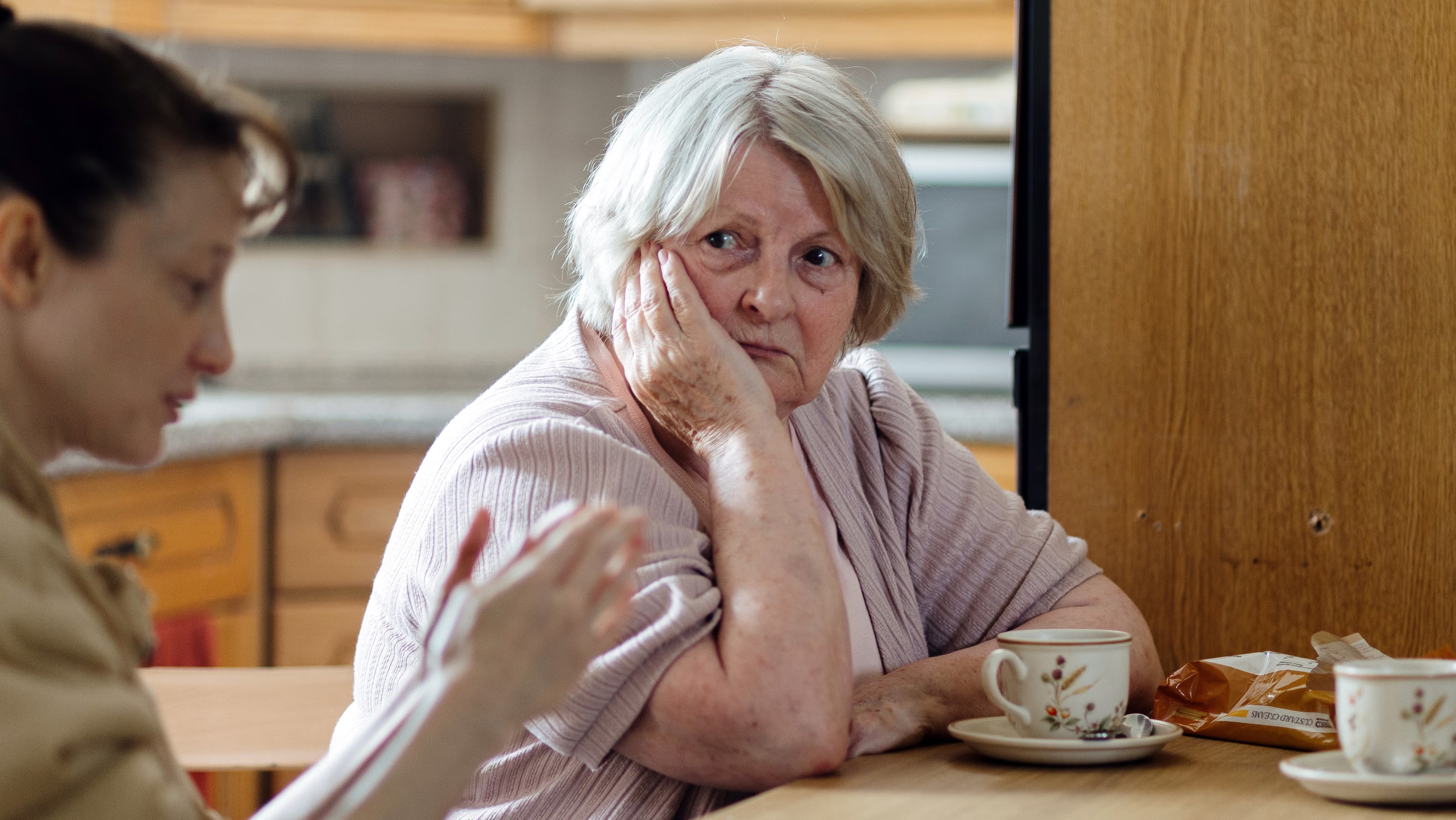
Since breaking into the British independent film scene with his excellent low-budget debut London to Brighton, writer and director Paul Andrew Williams has worked extensively in television and cinema from directing episodes of ITV dramas such as Broadchurch to crafting his own stories like 2021 revenge flick, Bull. His latest feature is Dragonfly, a social-realist drama with psychological thriller elements set in a working-class English town. When old-age pensioner Elsie (Brenda Blethyn) feels neglected by the nurses that visit her daily, her rough-around-the-edges neighbour Colleen (Andrea Riseborough) steps in to care for her, accompanied by her enormous bull terrier, Sabre. The women strike up an unlikely friendship but Elsie’s son John (Jason Watkins) worries that all is not as it seems.
I was fortunate enough to sit down with filmmaker Williams to discuss the piece…
I was struck first of all by how the characters were shot in the beginning, through open doors in their homes. Can you speak on why you approached it that way?
I thought ‘let’s try and see these people’ and get a glimpse of them, you know what I mean? It was the idea of observing someone but not being allowed in yet. I didn’t really learn specific ways of shooting specific moods so I just sort of go with how I feel – but I didn’t want to intrude too soon. The characters are inviting us as an audience into what is their life so we do that quite slowly.
In relation to the composition, you have an exterior shot where Elsie and Colleen’s houses are like mirror images of each other, reflecting their similarities as they both struggle with deep loneliness. Am I right in thinking that it started with straight-on symmetrical shots and shot at more of an angle as the film progressed to illustrate them coming together in a way?
I’d like to say yes but I’m glad it came across that way. For me, the idea of showing those two houses together at the beginning was about showing how similar and connected they are — like two sides of the same coin. As the characters get closer, the shots change but also, if you just kept repeating the same composition, it would get boring. So we’d think, “Okay, we’ve done that shot; let’s try something different to shake it up.” But if I’m absolutely honest, as a filmmaker, sometimes the wide shots and establishing shots are the last thing you think about. You’re so tight for time with the performers that often establishing shots are pushed. You can get to the end of a shoot and realise, “shit, we’ve got no establishers!” so you really have to crack on.
Touching on working with actors — you’ve worked with some amazing veterans of British cinema like Vanessa Redgrave, the late Terence Stamp, and now Brenda Blethyn in Dragonfly. Does it make your job easier as a director, to work with performers with so much experience?
Yeah, I think so. A good actor reads the script, gets a sense of the character, and you might have a little conversation about it. You can see if they’ve got a good interpretation of the character — and trust them to do what they do. The more experienced they are, the less you need to talk about it. Some actors like to be talked to about their role all the way through, and others prefer to rely on their own instinct. When you have great actors, that’s what they can do.
Andrea Riseborough is such a chameleon of a performer — she can shift between big Hollywood productions and intimate independent films like To Leslie or Dragonfly…
She’s such a superb actor — as are Brenda and Jason. What I found most incredible was that Andrea could talk afterwards about something she did which in the room seemed so natural, but certain small moments are actually so thought out. Her and Brenda’s interpretations of their characters really made the film what it is.

Her character was fascinating. The film really plays with audience’s perceptions in doubting Colleen’s intentions. From a screenwriting perspective, how did you approach crafting this doubt through pre-conceived notions?
My own judgments and preconceptions of characters and the situations we get into are the same as anyone’s, so I understand that audiences will have those about Colleen. But you also have to go further — to look at how someone’s behaviour comes from their background and upbringing, and what they’ve learned as an individual. That being the case, it really is important to try to find some understanding and be as open as you can be.
In terms of style and genre — Dragonfly isn’t a horror film per se, though it has horrific moments. There’s a tension built even with the presence of Colleen’s dog, Sabre as many are afraid of big dogs like her. How did you weave horror-like elements into a non-horror film?
I think it depends on whether you talk about it as horror or tension. Of course there is tension. Tension and horror are in the same room, but they’re not the same thing. Realistically, in some people’s eyes a big dog can be quite a scary presence. Audiences might be as afraid of the big dog as they are suspicious of Colleen. You might ask why someone would have a dog that you would be afraid of? But actually, that dog was soft as shite in real life! Aside from when she pushed into barking, she’s soft throughout the film too. Again, it’s one’s own pre-conception that builds that tension.
What’s coming up next for you as a director?
I’ve got a film I’m hoping to shoot next year. It touches on grief, loss, regret, love — all those human emotions. For now, we just want this film to do well enough and for as many people as possible to see it. That always helps in getting the next job!
Do you feel like you’ve changed as a filmmaker — thinking back to London to Brighton through to now? Do you face the same challenges now as you did when you started out?
Making a film is always a challenge, and getting budgets together, whether they’re big or small, is really tough because a lot of the time, films don’t make any money. But if there’s a story I feel I can tell that makes people feel something, I want to do that. As I get older, what’s important to me is making people experience an emotion of some kind — even in my last film Bull, there’s emotional turmoil there but it’s quite tense and scary too apparently.
I loved Bull so much – it was my favourite film of the year it came out and I’m such a fan of Neil Maskell. Like you say, it’s tough to get films made so we need to champion independent film and get as many people as we can to their local cinema to see films like Dragonfly.
Absolutely. That’s very kind of you to say.
Dragonfly is out now in selected UK cinemas

 Cinema Perspective