

Following on from the success of indies in his home country of Germany, writer and director Jan-Ole Gerster’s latest work Islands marks his English-language feature debut. After having its world premiere in Berlin back in February, the film screened at Edinburgh International Film Festival before going out on UK general release this month.
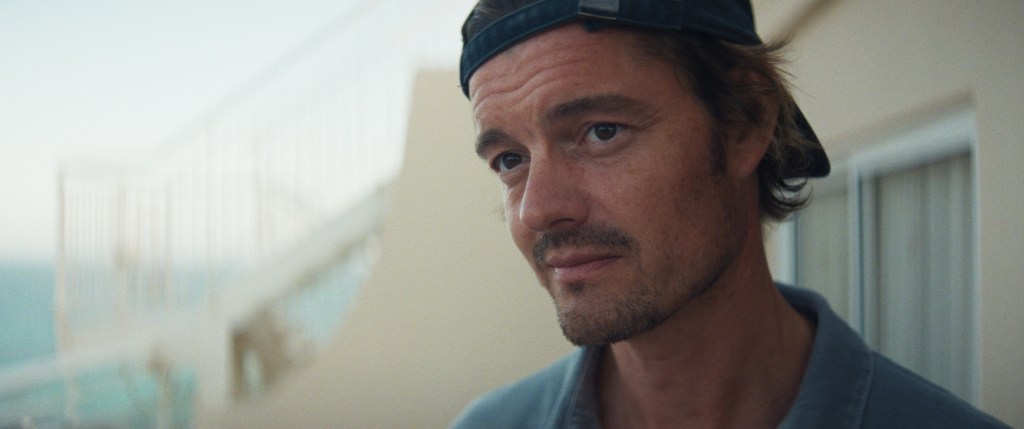
Sam Riley stars as a has-been pro turned tennis coach Tom who works out of a holiday resort in Spain, usually whilst hungover from partying at the local club the night before. His hedonistic lifestyle is upended when Anne (Stacy Martin) and Dave (Jack Farthing) arrive on the scene and ask him to give their young son private lessons. What follows is a suspenseful noir mystery with more twists and turns than a Grand Slam winning rally. I took the opportunity to sit down with Gerster to discuss the piece…
I hear the story came about after your own visit to a Spanish resort. Can you tell me a little about that?
Yes, it’s based on my experience and observations when I first visited Fuerteventura many years ago. I had no idea what to expect. It was just like a last minute thing, you know, in one of these endless dark, rainy and cold Berlin winters. I wanted to escape to a warmer place and I ended up there. At first sight, the island to me was like volcanic landscapes and like rotten hotels, but the more I discovered the more I understood the cinematic value of the landscape. I started to feel the urge to make a movie there. I had one of these little apartments and from my balcony I could see a tennis court. The sun bleached the surface and the net was hanging through the rusty cage. There was this tennis coach playing hundreds and hundreds of balls over the net.
So you created the character of Tom from there and the story followed?
The story more or less found me. Somebody who’s living a life in so-called paradise but he seems to be stuck in a tragic monotonous loop that he can’t get out of – at least like that’s what I made out of his observation. I embraced what was already there for the film; the light, the colours, the heat, this big clash of holidaymakers and people who have to work there. Everything became an inspiration, so the thing came naturally and it kind of turned into a noir. I thought I was going to write a drama about a washed-up character, something along the lines of The Wrestler, then more and more noir qualities were revealed to me during the process. I didn’t really have a story in the beginning.
I noticed the screenplay ended up being a collaboration between you and two other writers. Usually you only see this many writing credits on big studio blockbusters – can you talk a bit about how the story was fleshed out from your initial idea of the main character?
I love writing and I hate writing. It’s like Dorothy Parker said, “I hate writing, I love having written”. Yeah, that’s right. Before islands, I was working with a co-writer from Slovenia called Blaž Kutin, and we were kicking ideas around and I told him about the tennis coach who was still on my mind. We started to work on it, the two of us and we developed the first draft, Lawrie [Doran], our British co-writer, is somebody that we met at a lab for young filmmakers. We all met through the TorinoFilmLab and so we sent Lawrie the script just to hear his opinion, but also to make him polish the language because obviously we’re not natives. We had to send the script to producers, investors, actors, and we wanted to make sure that there was no clumsiness in the language, so Lawrie gave it, you know, a little bit of a polish. He had so many great notes and ideas that he also became credited throughout the process. It wasn’t like the three of us sat down to do it – three middle aged men to write about a man in crisis! [laughs]
With you being German, the setting being in Spain, but the characters being British, there’s a real mix of cultures involved. How was that aspect of it, especially with it being your first film in the English language?
Most of my colleagues are not that eager about shooting outside Germany in English. I have to say I was always tempted and I was always looking for a good opportunity to go for it, but it had to feel natural. I had to feel like I’m in control. There are as many British tourists at these resorts as there are like Germans, maybe even more. They have like British supermarkets where you can buy vinegar crisps and British breakfast tea and it’s like this little British world. They share a lot of weird similarities like, you know, daytime drinking and sunburns all shades of red, but I thought this was maybe the best opportunity for me to make an English language film. It was like neutral ground for all of us.
Sam Riley is an actor I’ve admired ever since watching him play Ian Curtis in Control many years ago. He’s done many great supporting roles since but brilliant to see him get another leading role on the big screen…
I think this is also the reason why he connected. I don’t want to get too personal here, but I think he also mentioned this in some interviews about his connection to the character. He knew a thing or two about missed chances or failed opportunities, and these are the subjects of all of my films. I seem to be terrified by the idea of living the wrong life and therefore I always come back to these characters who seem to be stuck. That was also something he could relate to.
He has like more of a rock star vibe going on than a tennis player but when I met him, I realised really quickly in our first meeting that he brings so many interesting vulnerabilities and charm. All these things, like his physicality, his slightly insecure smile, and his very dark smoky voice – all these were interesting and helpful aspects that he was bringing to the character in order to not make it appear like a cliche. I mean Tom was always supposed to be a bit like a cliche, but a cliche that we can relate to going through an existential crisis. I think in the wrong hands this character could have become very one-dimensional but Sam has great talent and instincts. He became a guy who is deep and multi-layered and is realising something about his misery. I was amazed every day working with him.
Like a lot of sports, there have been biographical films about tennis players such as Björn Borg and Billie Jean King, but with Luca Guadagnino’s Challengers last year and now Islands, tennis is having a real cinematic moment. Why do you think that might be?
There’s such a remarkable style to it, I think. Also, it’s one on one but they say about tennis that it’s something that you play against yourself. So much of it depends on your mental strengths, and if you can control yourself. It seemed to have such a comeback not only in cinema but I think people watch tennis again on the TV. It wasn’t the thing to watch for a couple of years, maybe even decades. Maybe it was different in Britain because you have Wimbledon and everything, but I remember the 80s when I was a kid and Boris Becker and Steffi Graf were like our biggest stars – it was such a hype. Everybody wanted to play tennis then and it’s back again. Everybody’s into tennis now!
Islands – in cinemas 12th September

 Cinema Perspective