
Earlier this year I attended Berlin Film Festival and the final screening of my trip was the gripping Swiss-German drama Late Shift which follows an eventful day in the life of surgical nurse, Floria who is brilliantly portrayed by Leonie Benesch. It was one of my festival highlights and ahead of its UK release next month, I was fortunate to sit down with its writer and director Petra Volpe to discuss the film…
It feels like very important, especially post-pandemic, to focus a film on the experiences of a nurse. What drew you to tell this story initially?
Well, I had lived with a nurse for many years before COVID even, and I kind of observed how the conditions she worked under got worse and worse, and how it affected her deeply. I just always felt like the work I’m doing, at home writing screenplays, was so banal compared to what she encountered every day. It’s such an emotionally complex but also technically complex job.
COVID came and everybody was clapping and everybody was very aware of how grateful we have to be towards nurses and then we forgot it again. There’s a huge shortage of nurses everywhere globally as you can see in the statistics in the movie; in Switzerland, Germany, the UK, and America and this idea kept brewing. I read a book by a German nurse who just describes one shift, and I thought ‘this is the movie’.
What was your preparation ahead of the production?
I did a lot of research, I went to hospitals, I talked to dozens of nurses, and I had consultants on the script. It was clear that we had to be very precise if we want to put the job in the centre of the narrative. We had to be very, very accurate in the way we’re telling the story.
You had Judith Kaufmann as your cinematographer, who I know you’ve worked with before. I was interested in the use of long takes that tap into this growing subgenre of ‘stressful cinema’. How did you come to shoot the film in this very specific way?
We said we’re going to strictly stay in the perspective of Floria and depict with the camera always on her. In the beginning we use a lot of long shots because she’s in the flow, you know. We saw her like an athlete, like a skater. She’s young, she’s motivated, it’s not for lack of motivation or strength that she doesn’t win this game, right? It’s because the system is against her. She can’t split herself in two.
We wanted to depict the beauty of the work in the flow, the energy, the athleticism, and the rhythm of the work we had observed. These long shots were great fun to shoot for me because I hadn’t done that before. Over time, she gets more stressed and it gets more fragmented, but we wanted to have the ‘one-take’ feeling. The trick was to tell a story that’s actually taking place over 12 hours, but to tell it in 90 minutes. We really wanted to create a physical experience for the audience.
The trainers Floria wears work as a visual metaphor for her mental state during the film. Box fresh in the beginning but scuffed and dirty by the end…
That was an inspiration I got when I went to the hospital. I saw these rows and rows of shoes and it’s really like they’re athletes, you know. It’s a complex job but you also need a lot of physical strength to do it, you know. That’s why a lot of nurses can’t do it until they’re 65, not under these conditions. That’s why a lot of nurses drop out way before they go on pension because they’re physically exhausted. Our nurse consultant trained Leonie (Benesch) and was also on set with us. She watched every shot with me to make sure everything was accurate. She worked in the ICU for 25 years and she worked during COVID – she has a physical aftermath and can’t work as a nurse anymore. She’s not the only one.
Speaking of Leonie Benesch, I’ve really enjoyed her recent run of workplace films such as The Teachers’ Lounge, September 5, and now Late Shift. After those days at work, I feel like she really deserves a week or two off.
[Laughs] Yeah, actually, because I saw her in The Teachers’ Lounge, I didn’t dare to ask her because I thought surely she must be tired of playing professionals…but in the end I looked at a lot of actresses but didn’t find my Floria and then I thought, ‘she has to make the decision for herself’, so I sent her the script. I think Leonie responded to the script, and she fell in love with the character and the physicality of the role. Even though there are similarities with The Teachers’ Lounge, she’s a very different character and has a very different drive. I think she really loved the idea to play an action figure. You know, there’s not one moment where she’s not doing something, and so I think that was very attractive for her.
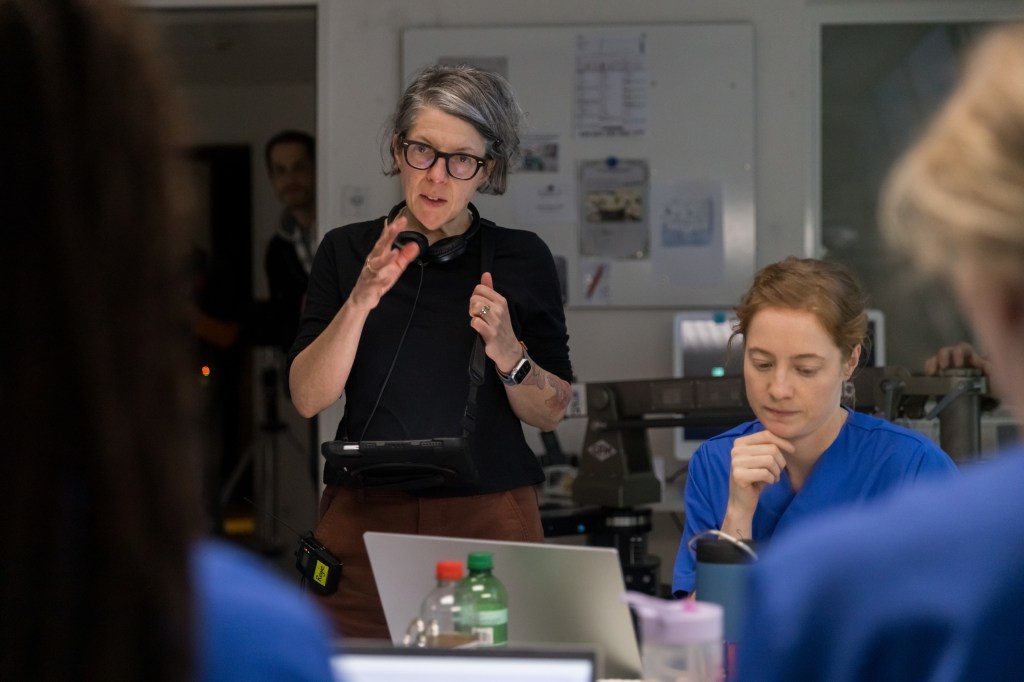
In amongst the stress and tension of the film, there’s a really comedic moment involving a patient’s watch. Was this a tricky tonal shift given the subject matter?
I think you need both, you know. You need a moment of release because it also reflects the work of nurses. Nobody has a more dark sense of humour than nurses, and if you spend time with nurses they laugh a lot. I think it’s a form of release and you need humour to do this job. I always find it interesting to find humour and moments of levity in drama, and I think the contrast makes both shine more in a way. I don’t want to give the scene away and we shouldn’t, but this was something that the nurses who consulted me opposed passionately and said, ‘you can’t do this’, and I said, ‘but you have fantasised about doing it, so let’s just do it because it’s a movie and we can do it’. It’s always a big moment in the audience, this scene.
Definitely. This scene stood out to me whilst watching it in a theatre. It’s a memorable moment.
I think it might be memorable because the audience is also released from tension, you know. We really wanted to make a movie that makes you feel as if you, as the audience, worked the shift. From the first moment, you feel like you’re the nurse and you’re in distress. She will go there the next day and do the shift again, and we have to be very aware of that what it really means to do this job. There’s such a distorted image in the media about nurses. They’re usually in the background, even in hospital TV series. They’re never the main characters even though on a hospital ward they are the main characters. It’s not the doctor. They come in five minutes in the morning and in the afternoon, but it’s the nurse who is by your side.
What was the biggest challenge you faced whilst making the film?
I think it was definitely the precision. We knew this movie is a love declaration to nurses and their work but if we do that, we cannot make mistakes because nurses are also very strict and have to really be accurate. At the same time we’re making a movie, right? It has to be entertaining, it has to have a certain flow, we have to condense certain things, but to what point can we condense it so that it’s still authentic? How can we make it cinematic but authentic? The line between this was very challenging. It started in the screenplay and then on the set and then in the editing. It was constantly that question. How far can we push the narrative to make a good cinematic experience, but also really staying true to the job of a nurse? We purposefully chose not the worst shift possible. Believe it or not, this is not even the worst. This is kind of a normal shift for many nurses.
What’s next for you? I read that you’re making a film called Frank & Louis. What can you tell us about that one?
Yeah, we just shot it in the UK actually. In Shrewsbury. It’s a prison drama that also involved a lot of research. It’s a story that takes place in an American prison, but we shot it in the UK. It’s about Alzheimer’s and dementia in prison, so it’s interesting.
If you had free rein to work on any film you wanted, which genre would you like to take on and who, from the past or present in this dream scenario, would be your lead?
Oh my god, that’s a difficult question. I do a lot of social drama and I love it, but sometimes I also need levity. I think I would love to work on like a big melodrama – something very fluffy for a change. There’s so many wonderful stars. I love Monica Vitti, I always did…or Anna Magnani – the Italian stars, because I’m half Italian, so anything with those ladies would’ve been a dream.
Late Shift – in UK & Irish cinemas 1st August

 Cinema Perspective