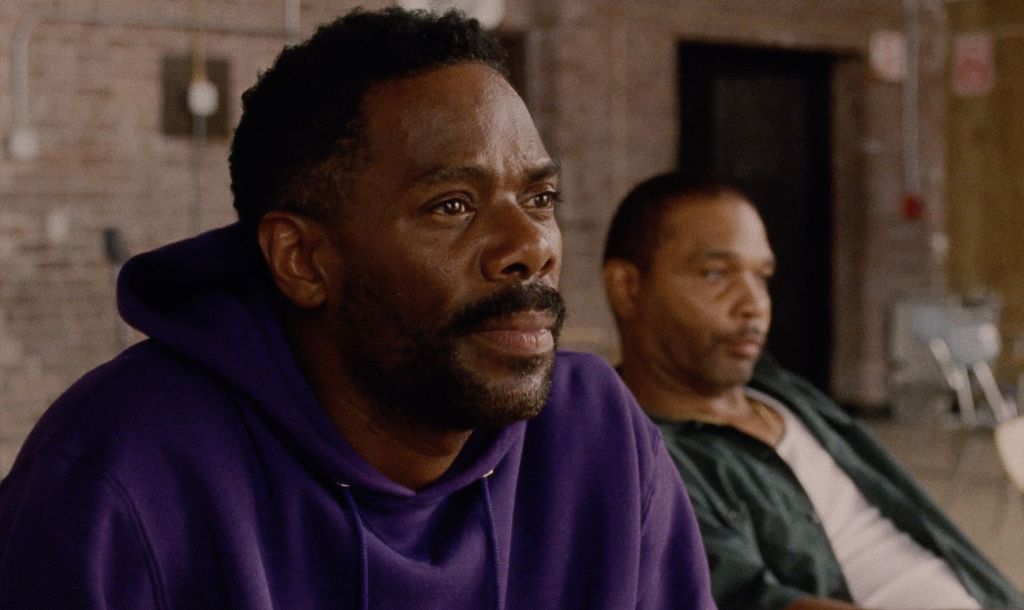
In 1996, the Rehabilitation Through the Arts (RTA) was founded by Katherine Vockins at the Sing Sing Correctional Facility in New York. This has spawned countless theatrical pieces in maximum security prisons and provides convicts with a sense of community and creativity as they serve their sentences behind bars. Adapting one of the progam’s many stories for the big screen, Sing Sing follows inmate John ‘Divine G’ Whitfield (Colman Domingo) as he and his fellow prisoners as they attempt to stage an original production titled Breakin’ the Mummy’s Code. I was fortunate enough to sit down with director Greg Kwedar to discuss the film…
Obviously Sing Sing is a prison movie but it doesn’t have the trappings of what we’ve come to expect from this subgenre. How did you approach telling a story with such dark themes but with the light that shines through your film?
You know, I think it’s self-evident inside this world and within the program and I think if you really are there to witness it, there is a wonderful warmth and life force emanating from this work and this program despite a dark environment that surrounds it. I think prison is the setting, but it’s not the focus. The focus is on these men and their work and their discovery of the beauty and possibility within them. This is inherently a light – a true light that’s emanating out of them that we’re attracted to.
Speaking of light, there is a lot of literal light in the aesthetic of the film and you really make the most of the beautiful surroundings of the Hudson River with the sun shining into the prison yard. How did you go about achieving this visual style?
I think we were just really drawn to the collision of these realities, you know, where the stunning natural setting of the Hudson River and the rolling hills juxtaposed with all the razor wire, the stone walls, and the guard towers. It kind of breaks your brain a little bit when you look at that, so we tried to allow the rest of the visual language to be a dance of those conflicting realities. A big breakthrough for us in working with Pat Scola, my cinematographer, was to be drawn closer to people, and the power of conveying the infinite landscape of a human face. Despite the claustrophobic setting and being in an incarcerated space, you could find a limitless horizon by what’s coming off and out of someone’s eyes.
And what a great face and great presence your leading man Colman Domingo has. I loved the way your camera subtly zoomed into his face during the group discussion scenes. How was it working with him as an actor and a producer in terms of getting their crucial central performance right?
He was really integral and was involved in every level of this movie as a producer, as a storyteller, and as an actor. I think because of his complete involvement, he was able to unlock the magnificent performance. He told me early on that he was setting an intention for his character in that he wanted his performance to be honest, to be elegant, and to be tender. What I didn’t realise was that could be a prompt for me as a filmmaker as well to see to it that every moment we were creating on screen would live up to those three pillars.
He’s such a commanding actor and presence, but he’s also a very generous actor and I think that might be built upon the fact that he’s been in support of a lot of other actors in movies for decades and now that he’s truly in leading man status, there’s a humility that he’s kind of recognised to get where he is. He makes sure that everyone around him feels seen and cared for, and that is sort of a testimony to his values and who he is as a person. He brought a lot of his own playfulness and personality into the role in a way that was so contagious and attractive. You’re kind of lifted up every time you’re around him and it’s great to see him bring some of that into this performance.
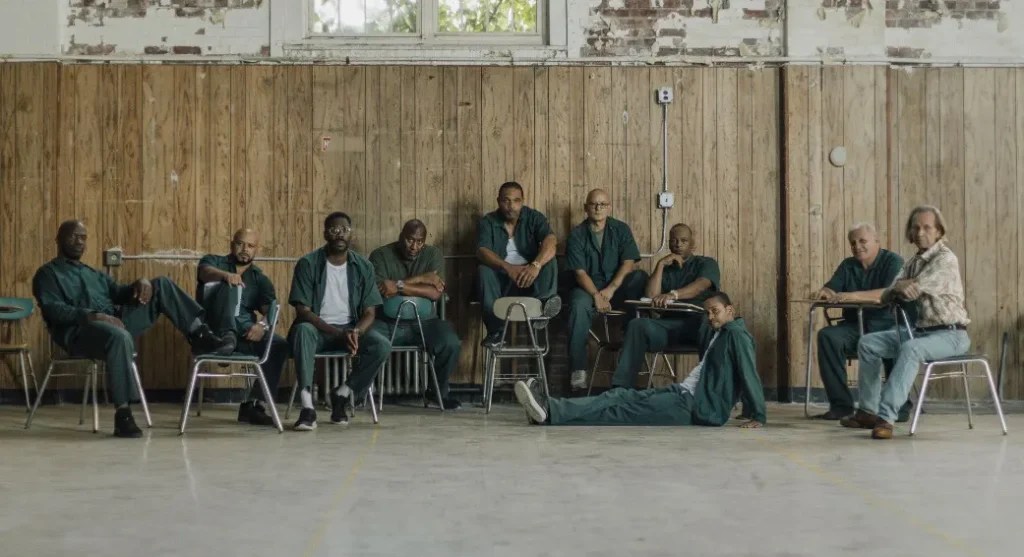
As a lot of the other inmates are played by themselves, there’s a real authenticity to the acting. What was it like working with this cast as I imagine that even though they have experience on stage, this would be a lot of their first times behind the camera?
Yeah, for most of our alumni cast, it was their first ever film role and they have an extraordinary amount of history and training on the stage – that happens to be our exact setting for the movie as well so it wasn’t a hard transition honestly to film! They’re so open and receptive, and kind of game to try anything. No matter what you bring in the room, they’d be like, “all right, let’s get it up on its feet and see how it feels. Let’s give it a go”. That kind of enthusiasm wasn’t naïve – it was a genuine excitement because everything was new and alive for this group of men and it really vibrated through our entire crew. A lot of us jaded filmmakers have been beaten down by the industry, so to witness a film set through their eyes really brought us back to the joy that we have in the work.
I thought Clarence Maclin in particular was incredible. He has a menacing volatility that’s great to see. How was it working with him to get this type of knife-edge performance?
It wasn’t that difficult to be honest because he is such a presence, you know. I’ve known him for over eight years and when I first started on the project, I met him and I was aware of the immense potential. He was very numb, you know, through the program, but you could feel being able to translate to the screen in a profound way and it’s the charisma he has, but also the depth and energy that emanates off of him is so compelling. When you add that into dancing off of Colman, there’s something about their chemistry that is so thrilling to watch on screen.
You mentioned previously about being beaten down by the industry. I was interested to read that you were studying accounting before you got into filmmaking. My day job is in finance and accounting so I was wondering if you could talk a little about that change in your life?
Well, when I first discovered that filmmaking could be a possibility for me, I was going into my senior year of accounting at my university in Texas and I kind of stumbled onto a film set for a short film in Sydney, Australia. I was playing sports there at the time. It was like the electricity of this beautiful collaboration across all of these art forms under one vision, which is filmmaking…it was kind of like going from black and white to colour for me, you know, and I just knew that this is what I wanted to do. When I went back to my senior year, every second of accounting was like someone stabbing me with a little knife, and I ended up getting to the first exam of the semester and dropping out in the middle of a test!
What does it mean to you to have the European premiere of Sing Sing here in Edinburgh?
I am really honoured to be at the longest continuously running festival in the world. There’s so much synergy around the spirit of our movie and the spirit of what’s going on in the city right now. We’ve been screening this movie consistently all over the United States for the last several months and I’ve found that in a lot of these audiences, there’s so much that we’re all sharing no matter what room you’re in. Every audiences feels distinct so I’m excited to see what is uniquely special about this group of people in this room tonight!
Sing Sing has its European premiere at Edinburgh International Film Festival and will be released in cinemas nationwide from 30th August

 Cinema Perspective