
Everybody of a certain age remembers the craze of the BlackBerry phone, marking the beginning of the smartphone obsessed era we’re still living in today. However, not everybody will know the story behind the device. Based upon Jacquie McNish and Sean Silcoff’s book Losing the Signal: The Untold Story Behind the Extraordinary Rise and Spectacular Fall of BlackBerry, independent filmmaker Matt Johnson brings the tale to the big screen in his trademark mockumentary style as a writer, director, and as an actor. I was fortunate enough to have the opportunity to discuss the film with him…
What was it about the book that made you think it’d fit into the unorthodox mould of how you approach making films?
I think it was the first time I’d ever seen a true story and thought that I could do something in the world of a true story that audiences would think is fake, because I love doing things that seem fake where you don’t know what’s real and what’s not real. Because it was a real story and we had a book to base it on and a product that people know, it just seemed like a great challenge to me to present a true story in a style where audiences would think ‘this can’t be real’.
You mention your style and this is something that feels very specific to the film – shooting in that mockumentary manner. Is that a hard sell to actors when you’re trying to get a film off the ground?
Well, you know, I would say that the actors at first might have been like slightly wary of it but then as soon as they see what it does to the working schedule, I think they really came to love it because it meant that each scene, rather than being cut into the shots and takes, turned into a bit of a stage play. Rather than doing all this very specific coverage of lines, we just ran entire scenes and shot them as though we were shooting a documentary and that made the actual performing a lot more fun and diegetic.
And in these really long takes, am I right in thinking that things happen that aren’t necessarily planned but are left in the final cut? Where one of the office workers falls off his desk chair?
If you’ve seen the film, you know this shot – it’s when Jim is going into the sales room and throws a BlackBerry at one of the sales guys. That actor’s name is Lyndon Casey and he’s a filmmaker and yeah, he just went for it and you see him actually fall over. If everybody’s staying true to their character and they’re not reaching outside of their character’s psychology then the things that can ‘go wrong’ is not a long list, like apart from a camera turning off or literally falling over. Unless something truly breaks the diegesis of the picture then just about anything is a success.
With the little glances to the camera, it reminded me in some places of The Office, particularly the original UK version…
I think that in some ways it really discovered more than a way of shooting – a way of acting. I think that’s what Ricky (Gervais) came up with and that has really outlasted that show. People will always talk about the aesthetic but to me, the aesthetic is a gateway into a style of performance – the character who knows they’re on camera and yet is told to pretend you’re not on camera. That’s so addictive to me. Obviously that existed in pure documentary form before but as soon as I saw it, I wanted to do it in a way that’s like a little bit more deliberate, but you’re still getting that same comic effect. It’s a totally new form of psychology that when movies were doing this before, it was an accident and it was an error and it was an example of bad acting. It’s this amazing trick where all of a sudden it transforms self-conscious ‘bad acting’ into really strong performance, right? What I love is it takes your weakest trait and turns it into your strongest.
In terms of the script, you mentioned in a Q&A that this is probably the most conventional approach you’ve taken. What was the process like in collaborating with your co-writer?
Look, I really hate writing. I find it quite painful but once it’s done, it’s great because then you have like a real document that you can depend on and you can lean on and that’s the part of it I love…but it’s a long process. It’s mostly rewriting and yeah, I find it quite painful.
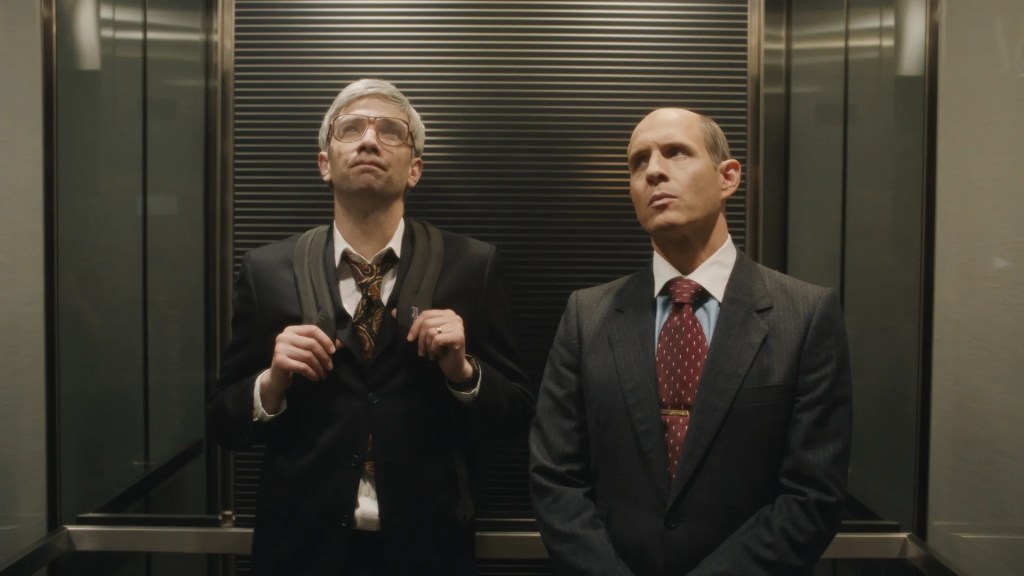
Comparisons have been drawn with Adam McKay’s The Big Short. Can you speak on how much it influenced you so much in terms of the tone you were trying to create?
More than anything, I think The Big Short is well…it’s a bizarre film. What they do really well is how they set up those camera rigs. They sort of invented a camera setup that is so, so usable where you basically mount these long lens cameras on rolling rigs and they let you do all of these moves with the camera while they’re floating that give it a kind of handheld feeling even though the lenses are so far away, which I just love. Jared (Raab, the cinematographer) and I watched a lot of behind the scenes documentaries with the cinematographer of The Big Short to try to steal exactly how they built their camera setup because we knew we were going to be in a lot of the same situations.
I enjoyed your promo with Letterboxd where they let you read through all the reviews…
I haven’t got a chance to watch that but I have heard that they used all my cruellest stuff, which is funny to me.
You got your own back on a friend of mine whose review was ‘when you buy The Big Short on Wish’…
Oh right, yeah. This was a guy who really hated the movie. Tell him I said hi! [laughs]
I will. He shared your scathing criticism of his profile. I suppose it’d be boring if we all liked the same films.
He shared it? Good for him, that’s really brave – that’s awesome. And yes, I couldn’t agree more. That’s the whole reason that I fell in love with film when I was a kid…everybody feels so differently about it.
And if you could work with three actors, from the past or present, in your dream film, who would they be?
I mean, if I’m hanging out with these guys, you know what, maybe I should just do all directors who are also actors. Yeah, Orson Welles, Spike Jonze and John Cassavetes. I think that that would be like a hilarious movie.
Cassavetes comes up so much when I ask this question – it’s clear how much of an influence he had on creatives…
He was the king of performance and so any filmmaker who loves actors as much as they love cameras is going to talk about John Cassavetes!
And while we’re talking about performance, I have to mention how great Glenn Howerton is in this film. What was it like working with him and getting this performance out of him?
I mean, he’s a total professional. It was one of the highlights of my career that I got to work with somebody who took the role so seriously and literally brought it every single take. He was never bad. It was amazing. He’s an incredibly talented actor and I think that we’re about to see him completely transform his career.
BlackBerry will be released in UK cinemas from 6th October 2023

 Cinema Perspective