
DVD & Digital

DVD review: The Hobbit: The Battle of the Five Armies

THE HOBBIT: THE DESOLATION OF SMAUG
After a combined running time of 1032 minutes, Peter Jackson’s six-part Middle-Earth saga draws to a close with The Hobbit: The Battle of the Five Armies, rounding off the prequel Hobbit trilogy. Picking up directly where the second instalment left us, Bilbo Baggins (Martin Freeman) and the squad of not-so-merry dwarves look on in terror as the recently awoken dragon Smaug (Benedict Cumberbatch) rains fiery hell over Lake-town. With the dwarf’s leader Thorin Oakenshield (Richard Armitage) back in his beloved Lonely Mountain in Erebor, will he maintain control of his kingdom or will he succumb to the greed that comes with the almighty power? Everyone and their army now feel a sense of entitlement to their share of the treasure that lies at the bottom of the mountain, so battle inevitably follows.
 I don’t think it’s unfair to say that the recent Hobbit films haven’t achieved the same sense of spectacle as the Lord of the Rings and the same problems from Desolation of Smaug carry through into the final part. The continuation of the elf-dwarf-elf love triangle is an irritating subplot, with Legolas popping up now and again to do little more than hop across stones and have a little moan. The development of Thorin’s story arc is, to me, one of the highlights of the series, culminating effectively in an interesting character study that explores what can happen when you get everything that you’ve ever wanted. His friendship with Bilbo provides a few touching moments, and helps bring the hobbit himself into what is supposed to be his story after all.
  In the midst of all the fighting and the questionable high frame-rate CGI, there are a few performances that deserve some credit. Ian McKellen and Christopher Lee are as strong as ever as the all-conquering wizards Gandalf and Saruman, their story nodding towards what is ahead, making it increasingly tempting to dig out the Fellowship of the Ring DVD. Martin Freeman comes into his own finally as Bilbo, the portrayal bettering as the character grows in confidence and stature. Richard Armitage impresses the most as Thorin, powerfully conveying the swaying nature of the character’s inner conflict. In an all star cast, Ken Stott, Stephen Fry and Billy Connolly stand out from the supporting actors, though the latter’s appearance is nothing more than an amusing cameo.
  By now, the sight of Peter Jackson’s Middle-Earth is comforting to fans of the series and the finale provides a solid, if slightly subdued conclusion. Taking an overview of the story, the Hobbit novel is aimed predominantly at a young audience and has a primitive plot at its heart. In its cinemakeover, Jackson’s vision has stretched and contorted it, turning Tolkien’s short book into a near ten hour epic, perhaps for monetary gain and to fulfil his own artistic ambition. Where some flourishes work and his flair for stunning set pieces is unfaltering, others sadly don’t. Despite its flaws, ‘The Battle of the Five Armies’ is an enjoyable closing chapter to what is arguably one of the best cinematic franchises of all time.
yellow_staryellow_staryellow_starhalf star
See the trailer:
Features

Top 5 Al Pacino Performances

Next month, the iconic Hollywood actor Al Pacino visits the United Kingdom to take part in ‘An Evening With…’ events in both London and Glasgow. I will be hoping to grasp the opportunity to ask him a question about his hugely impressive career. Until then, let’s celebrate how much of a talent he is, and reflect on the film performances that helped make him the legend he is today.

5. Scarface

scarface

‘Say hello to my little friend’ is arguably one of the most quotable lines in cinema culture, epitomising the egotistical drug-lord Tony Montana whom Al Pacino played in Brian De Palma’s crime thriller ‘Scarface’. It is set to be remade in the coming years but I doubt any actor of today could match the sheer screen presence of Pacino in his heyday.

4. Serpico
serpico

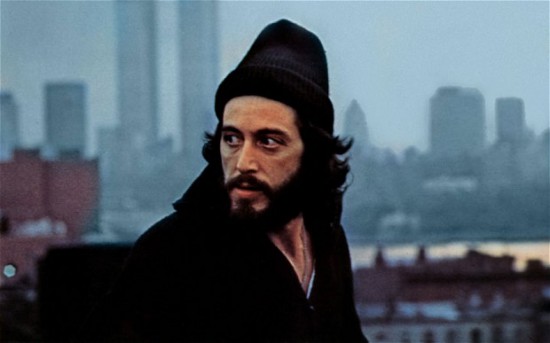
In a rare good-guy appearance, Al Pacino brilliantly took the eponymous part of patrolman Frank Serpico in Sidney Lumet’s police corruption drama. Sick and tired of the constant pay-offs taken by his cheating colleagues in the force, he goes out to expose his co-workers, but at what cost does justice come at?

3. Godfather Part I
godfather1

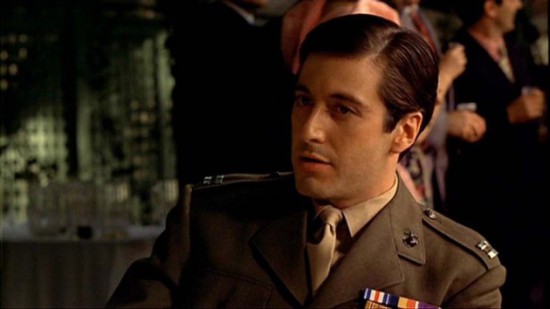
In the performance that launched him into the limelight, he is the soft-spoken youngest son of Don Vito Corleone in the first instalment of Francis Ford Coppola’s mafia trilogy ‘The Godfather’. His cool, calm and collected exterior is put to the test when the safety and well-being of his family is threatened, and he takes drastic action.

2. Dog Day Afternoon

dog-day-afternoon

In a ‘how not to rob a bank’ masterclass, Al Pacino co-stars as hapless dreamer Sonny Wortzik alongside John Cazale, who plays his on-screen brother in the entries that sandwich this one in the list. Sidney Lumet directs again and we see another side to Pacino where his character quickly loses control of a high-intensity situation and he is forced to face the consequences of his foolish decision-making.

1. The Godfather II

Al Pacino In 'The Godfather: Part II'Woody Allen And Mia Farrow In 'A Midsummer Night's Sex Comedy''

In the second part of Coppola’s gangster epic, the reserved youngster from the original becomes a fully fledged boss of the crime family, and will stop at nothing to keep his empire and his reputation intact. The transformation of Michael Corleone goes a long way to showcase the colossal talent of Al Pacino, and is recognised as one of the greatest character arcs in film history.

Shorts

Short film review: The Muse

muse
Muse -noun
  1. (Muse) (In Greek and Roman mythology) each of nine goddesses, the daughters of Zeus and Mnemosyne, who preside over the arts and sciences.
  1. A woman, or a force personified as a woman, who is the source of inspiration for a creative artist: Yeats’ muse, Maud Gonne
muse2
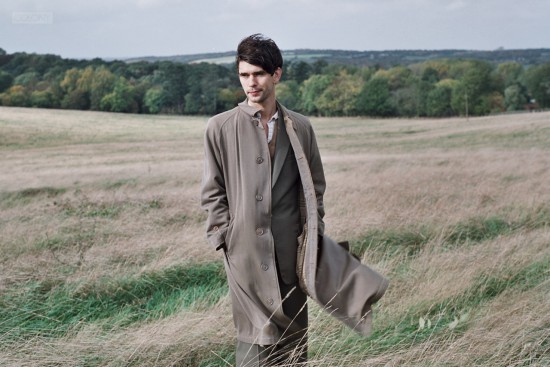
In the creative industries, it is vitally important to always be inspired for each and every project you take on and fashion photographer Tim Walker has turned film director to explore this theme further. His piece, simply titled ‘The Muse’ features Ben Whishaw in the leading role, who rose to fame in 2012 after playing James Bond’s go-to-gadget-guru Q in Skyfall. He plays struggling artist Edward who is lost without his muse (Kristen McMenamy), and left to reflect over what he had, mourning his source of invention and imagination.
It is refreshing to watch Walker liberated from still photography to work with the moving image, and his strong visual style transfers beautifully across mediums. Each frame of the film is deliberated over and could easily be captured to go on display. Structurally, the minimalist narrative floats through in a wash of ambiguity, as Edward mopes about in despair, his internal monologue the only dialogue, while his mermaid muse gazes out of a water-tank in what are beguilingly fantastical-flashback-dream sequences. I feel that it could benefit from the accompaniment of an exhibition space to fully flesh out the thought process involved, but with the behind-the-scenes bundle available at www.wearecolony.com, you can get access to the full film as well as stills, concept art, sketches and more!
See the trailer:

http://www.youtube.com/watch?v=rK4JTCByEQY

DVD & Digital

DVD review: The Infinite Man

the-infinite-man-sxsw-movie
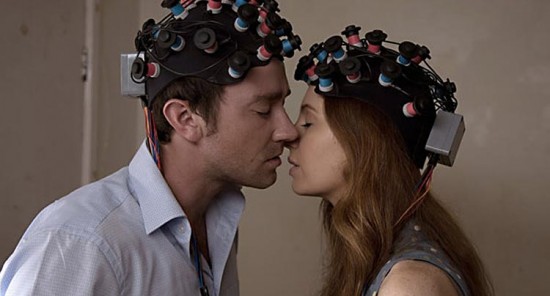
A new breed of films are surfacing in the forever changing cinema industry. Independent science fiction, or sci-findie if you will, is a forming genre which takes elements of futuristic technology – in this case time travel – and applies it to a simple story, with no aliens or laser beams in sight. Australian comedy ‘The Infinite Man’, written and directed by Hugh Sullivan, has one location, three actors but a great deal of creativity and intelligence. Dean (Josh McConville) wants to recreate the perfect anniversary weekend with his girlfriend Lana (Hannah Marshall). He takes her to same holiday resort, which unbeknownst to him is now closed and deserted, and has an agenda to repeat the same activities. However, when Hannah’s ex Terry (Alex Dimitriades) appears, his carefully laid plans go terribly awry.
One year later, a heartbroken Dean digs out a ridiculously looking time-travel device which he has cooked up ‘in the lab’ and proceeds to send himself and Lana back in time to give it another go. Of course, this backfires when his current self follows suit, trapping the characters in an infinite loop of misery, jealousy and hilarity. Despite the narrative repeating itself, it never becomes uninteresting and actually gets funnier as the plot develops and we see Dean become hysterical in his pursuit of eternal happiness. The dialogue has the same quirky edge and unenthused tones as that in the New Zealand sitcom Flight of the Conchords, and is delivered with impressive comic ability by all involved.
The inventiveness of the plotting means that the viewer is always kept thinking, and the low-budget environment becomes an intimate microcosm of unrequited love. I hope that the work will reach a wide audience after its festival reception, and it’d be intriguing to see where the ideas could travel with more money to spend. Until then, ‘The Infinite Man’ is substantial proof that big ideas can work well on the smallest of scales, and is a notable feature debut for film-maker Hugh Sullivan.
yellow_staryellow_staryellow_starhalf star
See the trailer: